




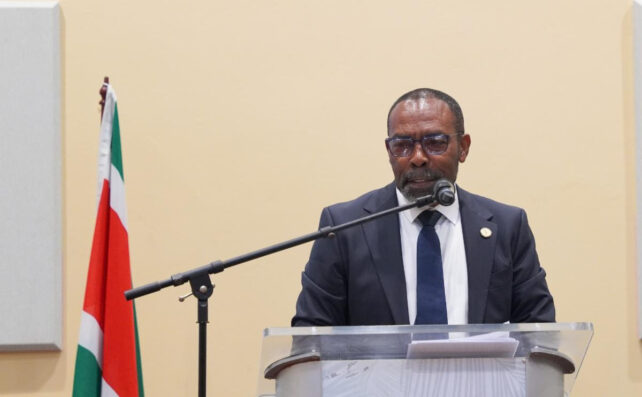
From January 20 to 24, 2026, a senior delegation from the Caribbean Court of Justice (CCJ) carried out an official visit to the Republic of Suriname, following an invitation from the Honourable Mr. Justice Iwan Rasoelbaks, President of Suriname’s Court of Justice.
CCJ reported via press release that during the visit, members of the CCJ, including Honourable Mr. Justice Winston Anderson, the Court’s President; Honourable Mr. Justice Peter Jamadar, a CCJ Judge; Sir Dennis Byron, a former CCJ President; and Gabrielle Figaro-Jones, the Registrar and Chief Marshal, engaged with Surinamese judicial officials, lawmakers, and other stakeholders at the Congress on Modernizing the Judiciary.
The event took place at the Torarica Resort in Paramaribo on 22 January 2026. The presentations focused on the CCJ’s structure, operational effectiveness, institutional setup, and the potential for Suriname to join the Court’s Appellate Jurisdiction.
During his speech at the Congress, President Anderson emphasized that joining the CCJ’s Appellate Jurisdiction would affirm Suriname’s sovereignty and independence, bolster regional institutions, and enrich the diversity of jurisprudence in the Caribbean.
Suriname’s legal tradition is rooted in civil law, which contrasts with most other Caribbean Community member states that follow common law principles.
According to the release, President Anderson proposed the creation of a dedicated Civil Law Chamber within the CCJ to handle appeals originating from Suriname.
He explained that this chamber would be staffed with judges well-versed in civil law jurisprudence. Proceedings would be conducted entirely in accordance with civil law practices, with appeals processed under procedural rules drafted in Dutch. All filings, evidence, and correspondence would be in Dutch, aligning with Suriname’s legal and linguistic environment.
As part of the official visit, the delegation also paid a courtesy call to Her Excellency Jennifer Geerlings-Simons, President of Suriname. The discussion centered on judicial reform efforts and the CCJ’s role in supporting Suriname’s modernization process and regional integration.
The Court says it remains eager to continue collaborating with Suriname as the country advances its judicial modernization efforts, in line with the CCJ’s mission to promote access to justice, regional unity, and the rule of law across the Caribbean.
Disclaimer: The comments posted do not necessarily reflect the views of DominicaNewsOnline.com and its parent company or any individual staff member. All comments are posted subject to approval by DominicaNewsOnline.com. We never censor based on political or ideological points of view, but we do try to maintain a sensible balance between free speech and responsible moderating.
We will delete comments that:
See our full comment/user policy/agreement.