




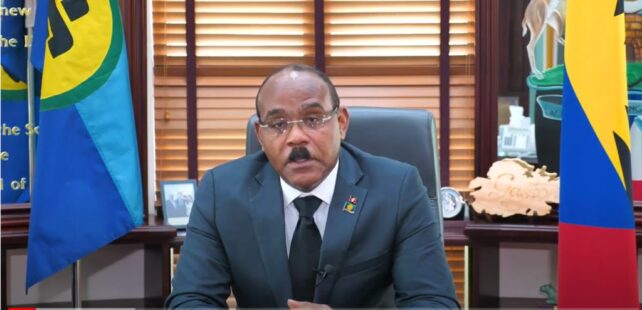
The Government of Antigua and Barbuda has announced plans to make Spanish the country’s official second language as part of a sweeping policy initiative aimed at strengthening regional integration and preparing citizens for expanded economic and diplomatic opportunities across Latin America and the Caribbean.
The decision was approved by Cabinet this week and will see the Ministry of Education begin restructuring the national curriculum so that Spanish becomes a core subject from pre-school through secondary school.
Officials say the move reflects the twin-island nation’s evolving regional relationships and the growing importance of multilingualism in trade, tourism, education, and international engagement.
Cabinet also pointed to the longstanding relationship between Antigua and Barbuda and the Dominican Republic as a major influence behind the policy. The Government acknowledged the significant contribution of the Dominican community to national development and described the initiative as part of a broader effort to deepen cultural and economic ties between the two countries.
Authorities believe greater Spanish-language competency will improve communication and workforce competitiveness while positioning Antigua and Barbuda to engage more effectively with Spanish-speaking nations throughout the hemisphere.
Alongside the language policy, Cabinet approved the launch of the Dominican Republic Integration Programme (DRIP), which is intended to strengthen cooperation in tourism, education, trade, and investment while providing additional support systems for Dominican nationals living in Antigua and Barbuda.
The Government also approved the creation of a dedicated Spanish Desk within the Office of the Prime Minister. The unit will serve as a direct liaison for the Spanish-speaking community and assist with access to government services and community integration.
Officials say the measures form part of a wider national strategy focused on inclusion, education reform, and regional cooperation as Antigua and Barbuda adapts to an increasingly interconnected global environment.
The Creole language, called the Negro language by the colonial authorities, represent today the identity, solidarity, resistence, and cultural pride of our people. Calling Creole “broken French” reflects a colonial bias, ignoring their complexity and separate linguistic identity, much like calling French “broken” Latin.
French is only the lexifier language for Dominican Creole. The substratist position says that New World creoles are relexified forms of African languages. That is, Dominican creole language has vocabulary from French (the superstrate laguage), about 84%, but the syntax can be traced to African languages (the substrate): Bambara, Bantu, Ewe, Fulani, Igbo, Kikongo, Kimbundu, Mende, Twi, Wolof, Yoruba…
So, the speakers of the Creole language must take pride of our own unique linguistic heritage.
The Creole language, called the Negro language by the colonial authorities, represent today the identity, solidarity, resistence, and cultural pride of our people. Calling Creole “broken French” reflects a colonial bias, ignoring their complexity and separate linguistic identity, much like calling French “broken” Latin.
French is only the lexifier language for Dominican Creole. The substratist position says that New World creoles are relexified forms of African languages. That is, Dominican creole language have vocabulary from French (the superstrate laguage), about 84%, but the syntax can be traced to African languages (the substrate): Bambara, Bantu, Ewe, Fulani, Igbo, Kikongo, Kimbundu, Mende, Twi, Wolof, Yoruba…
So, the speakers of the Creole language must take pride of our own unique linguistic heritage.
FRENCH should be our OFFICIAL 2nd LANGUAGE. Long time ago.
Creole is a Patois. Let it live and breathe as such. Stop wasting time and money trying to formalize it.
Just saying.
In Dominica the second language is French Creole. The third language would be Chinese.
You know I can understand French as a second official language in Dominica, which was originally a French colony, and at some time was dominated by Spai.
In the case of Antigua there’s no history such as that of Dominica.
The reasons given by Gaston Brown for selecting Spanish as an official second language doesn’t make much sense! There are only three main Spanish speaking islands in the Caribbean: Cuba, The Dominican Republic, Purto Rico; One may add Venezuela, Columbia and Central America.
Speaking languages: making an argument about economics is simply hogwash!
In Europe, it is mandatory that every student before graduation must take a foreign language: they, however; select a foreign language of their choice. I don’t think the European countries specifically adapted a language as an official second language!
So, I lived in England, Germany, been to Belgium, and experience almost every young person I spoke with either spoke French, English, German, or Spanish. Him is Chinese eh!