




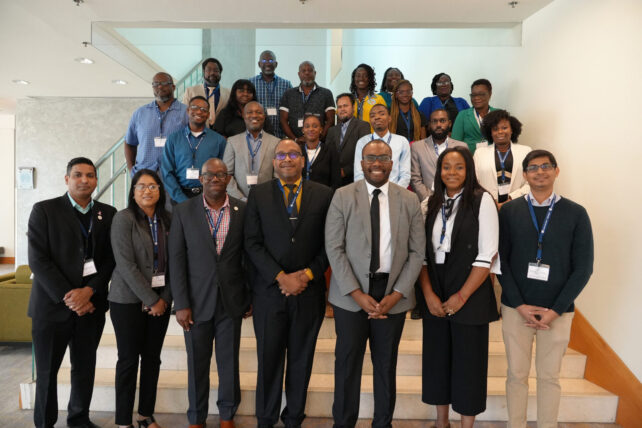
The Caribbean Public Health Agency (CARPHA) has successfully wrapped up a two-day regional training session in Trinidad and Tobago titled “Enhancing Vector-Borne Disease (VBD) Monitoring via Data Accuracy, Nowcasting, and Risk Matrix Utilization.” A CARPHA press release said the purpose of this gathering was to bolster VBD surveillance capabilities, enhance the precision and promptness of national data collection, and operationalize Early Warning Systems (EWS) across CARPHA’s member countries.
Seventeen participants from nine nations—Dominica, Barbados, British Virgin Islands, Grenada, Guyana, Jamaica, Montserrat, St. Maarten, and Trinidad and Tobago—attended. The cohort included epidemiologists, surveillance officials, statisticians, and environmental health experts.
“The same tools that help us anticipate dengue, chikungunya, malaria and other vector-borne threats are the tools that will help us detect and contain the next pandemic,” remarked Dr. Lisa Indar, CARPHA’s Executive Director. “By investing in better data, faster early warning and Caribbean tailored decision tools, we are helping our Member States move from reacting to outbreaks to staying one step ahead and protecting lives and livelihoods across the Region.”

During the opening address, Dr. Horace Cox, Director of Surveillance, Disease Prevention, and Control at CARPHA, emphasized the vital link between vector-borne disease work and broader pandemic readiness.
Building upon the groundwork laid during the initial workshop in August in Barbados, which concentrated on operationalizing VBD Early Warning Systems, this subsequent session advanced the application of risk assessment matrices and introduced nowcasting techniques. Nowcasting, an innovative epidemiological method, compensates for reporting delays and data gaps in vector-borne disease surveillance, offering a more accurate and timely understanding of transmission dynamics. This approach facilitates earlier identification of trend changes and supports more dependable real-time risk evaluations.
Dr. Brian Armour, CARPHA’s Technical Advisor for the Pandemic Fund Initiative, highlighted the significance of a region-specific early warning strategy. “Considering our geography, population size, and reliance on tourism, an outbreak in one CARPHA Member State can quickly escalate into a regional crisis,” he explained. “Funding from the Pandemic Fund enables us to create a comprehensive, regional early warning system that integrates indicator-based, laboratory, tourism, and event-based data, allowing countries to detect, notify, and respond more swiftly to emerging vector-borne and other public health threats.”
According to the release, throughout the event, participants engaged in practical exercises utilizing combined epidemiological, entomological, climate, and laboratory data sets. They enhanced their understanding of foundational nowcasting models, explored their application within EWS, and aligned early warning results with national standard operating procedures (SOPs). These activities aim to help Member States convert early warning indications into clear operational actions, such as intensified surveillance, verification investigations, and rapid vector control measures. Additionally, countries acquired new skills to determine the most pertinent indicators for inclusion in their national early warning frameworks, fostering the development of tailored, precise outputs and ensuring procedural consistency as threat levels increase.
The workshop also demonstrated how vector-borne disease-specific tools integrate into CARPHA’s evolving regional, comprehensive early warning surveillance system, developed through the Pandemic Fund Project. Participants examined how national systems can interface with CARPHA’s platforms while preserving data sovereignty and stewardship. They also discussed how enhanced timeliness metrics can minimize delays between detection, notification, and intervention during health emergencies.
CARPHA says that these effort directly supports the goals of thePandemic Fund Project by strengthening disease surveillance and early warning capabilities, building workforce expertise in data analysis and risk evaluation, and fostering coordinated regional responses to vector-borne and other epidemic-prone diseases that have the potential to escalate into pandemics.
Disclaimer: The comments posted do not necessarily reflect the views of DominicaNewsOnline.com and its parent company or any individual staff member. All comments are posted subject to approval by DominicaNewsOnline.com. We never censor based on political or ideological points of view, but we do try to maintain a sensible balance between free speech and responsible moderating.
We will delete comments that:
See our full comment/user policy/agreement.