




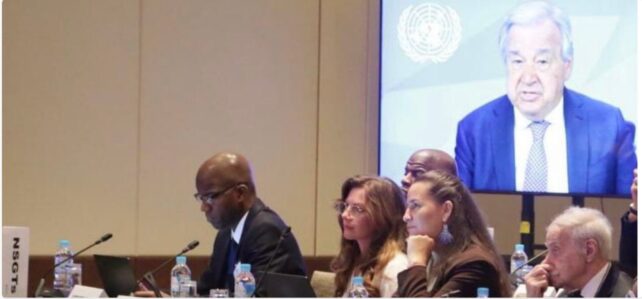
The British Virgin Islands (BVI) has urged the United Nations Special Committee on Decolonization (C24) to make greater use of its mandate to help advance the decolonization of the world’s remaining Non-Self-Governing Territories (NSGTs).
According to a Government of the Virgin Islands press release, the appeal was made by BVI Special Envoy Benito Wheatley during the UN Special Committee’s Caribbean Regional Seminar on Decolonization, which was recently held in Managua, Nicaragua. The seminar focused on the implementation of the Fourth International Decade for the Eradication of Colonialism.
Wheatley called on the Special Committee to utilize its good offices to facilitate dialogue between administering powers and their remaining territories in order to peacefully advance decolonization through one of the three options recognized by the United Nations: integration, free association, or independence.
He also urged the committee to intensify efforts to facilitate requests from Non-Self-Governing Territories for visiting missions, which allow the UN to assess progress toward self-government and decolonization on the ground.
According to Wheatley, “The Special Committee on Decolonization can make a difference in advancing decolonization by employing the major tools at its disposal, which include good offices and visiting missions. Both provide useful engagement and dialogue for both the Administering Power and the Governments and peoples of those Non-Self-Governing Territories seeking a full measure of self-government.”
The Special Envoy also provided an update on developments in the British Virgin Islands, noting that the territory’s government is seeking full internal self-government through upcoming constitutional negotiations with the United Kingdom. He further indicated that a referendum is planned for 2031 to allow Virgin Islanders to determine their preferred path to full decolonization based on the three sovereignty options endorsed by the United Nations.
While expressing appreciation to the Special Committee for dispatching a visiting mission to the BVI in 2024 and for its continued support of democratic governance in the territory, Wheatley cautioned that the committee’s relevance could be called into question if significant progress is not achieved before the end of the Fourth International Decade for the Eradication of Colonialism in 2030. The UN mission to the British Virgin Islands in August 2024 was tasked with assessing the territory’s political, economic and social progress toward self-determination.
The administering powers responsible for the remaining Non-Self-Governing Territories are France, New Zealand, the United Kingdom and the United States.
The 17 territories that remain on the UN’s list of Non-Self-Governing Territories are American Samoa, Anguilla, Bermuda, the British Virgin Islands, the Cayman Islands, the Falkland Islands, French Polynesia, Gibraltar, Guam, Montserrat, New Caledonia, Pitcairn, Saint Helena, Tokelau, the Turks and Caicos Islands, the United States Virgin Islands and Western Sahara.
Source: Government of the Virgin Islands press release issued following the UN Caribbean Regional Seminar on Decolonization in Managua, Nicaragua.
Disclaimer: The comments posted do not necessarily reflect the views of DominicaNewsOnline.com and its parent company or any individual staff member. All comments are posted subject to approval by DominicaNewsOnline.com. We never censor based on political or ideological points of view, but we do try to maintain a sensible balance between free speech and responsible moderating.
We will delete comments that:
See our full comment/user policy/agreement.