




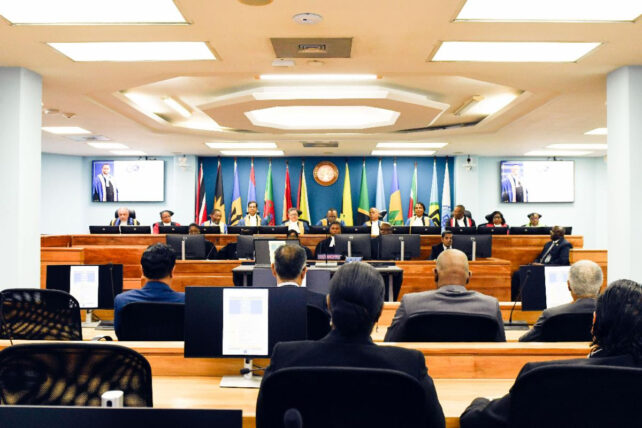
The Caribbean Court of Justice (CCJ) hosted a special session at its headquarters in Port of Spain on Monday, October 6, 2025, bringing together Judiciary leaders, distinguished guests, regional judicial officials, and staff members, honoring the formal inauguration of Honourable Mr Justice Winston Anderson as the Court’s fourth President.
CCJ reports that Justice Anderson was officially sworn in as President earlier that year on July 6 in Montego Bay, Jamaica, ahead of the 49th Regular Meeting of the Caribbean Community (CARICOM) Heads of Government.
Prior to his appointment to the CCJ bench in 2010, a media statement shared, President Anderson was a respected academic at The University of the West Indies (UWI) Faculty of Law. He joined UWI in 1988, eventually serving as a professor from 2006 onward. His roles at the Faculty included Deputy Dean, Head of Teaching, and General Counsel to CARICOM during a secondment. Additionally, he was the founding Chair of the CCJ Academy for Law, established in 2010.
During the special sitting, President Anderson reportedly emphasized the impact of the CCJ in enhancing access to final appellate justice across the Caribbean. Using Barbados as an example, he highlighted that the number of appeals from Barbados to the Privy Council over the 20 years prior to 2005 was 19. Since the establishment of the CCJ, the number of appeals from Barbados to the Court has soared to 105 over the same period—an increase of over 450 percent.
Nonetheless, he pointed out that the full potential of the Court has yet to be realized, noting, “there would have been a significantly larger number of CCJ appellate decisions had there been full compliance with the obligation in the CCJ Agreement for all member states to join the Appellate Jurisdiction of the Court. The opportunity cost of non-accession can therefore be measured in terms of reduced access to justice, which is also a denial of justice. Equally, there is a corresponding loss in the opportunity to fulfil the mandate of the CCJ Agreement to develop a Caribbean jurisprudence that is responsive to all areas of Caribbean life.”
The theme of expanding access to justice resonated throughout the event, echoed by various speakers. Chief Justice Ivor Archie of Trinidad and Tobago expressed his support, affirming that the judiciary of his country stands ready to collaborate with President Anderson to realize the vision of greater regional justice accessibility.
‘Today’s ceremony celebrated the embodiment and continuance of a dream long held across the region, a dream of a Caribbean jurisprudence shaped by Caribbean minds and serving Caribbean people.” Chief Justice Archie continued, “Although the dream is still under construction, there could be no better argument for its pursuit than the people who sat on and led the CCJ Bench.”
Senator the Honourable John Jeremie, SC, the Attorney General of Trinidad and Tobago, also shared his perspective, recalling his initial encounter with President Anderson during his time at UWI’s Faculty of Law. He described Anderson’s calm demeanor and integrity, adding, “over the years, I came to respect his deep appreciation for the rule of law and to our Caribbean project.”
Professor Rose-Marie Belle Antoine, Principal of The University of the West Indies at St. Augustine, highlighted that Anderson’s appointment was a win not only for the Court but also for the university. As outlined in the release, she urged advocates and judges who identify with the Caribbean’s regional ethos to reflect deeply on local issues and support the development or rebuilding of our justice system when necessary—affirming that President Anderson embodies this ideal.
The event also featured a message from former CCJ President, the Right Honourable Sir Dennis Byron, who expressed confidence in Anderson’s leadership. Byron reflected on some of Anderson’s landmark cases and his role in shaping the Needham’s Point Declaration, which provides a regionally approved framework for collaborative efforts against crime.
In her opening remarks, CCJ Judge Honourable Mme Justice Maureen Rajnauth-Lee praised President Anderson’s dedication to the region’s peoples.”Your respectful engagement with different perspectives and your steadfast commitment to collaborative problem solving have not only elevated the quality of our discourse and enriched the work of the Court but have also inspired each of us.”
Additionally, Ms Lisa Shoman, CARICOM’s General Counsel, underscored the critical importance of the CCJ in today’s volatile global environment. “More than ever, CARICOM depends on our commitment to integration, the rule of law, democracy, and respect for human rights. The Caribbean Court of Justice plays a seminal role in offering us guidance, support, and a guarantee of impartial decision-making in its original jurisdiction,” she stated. “The next seven years under President Anderson’s leadership will define and shape the future of the Community.”
Disclaimer: The comments posted do not necessarily reflect the views of DominicaNewsOnline.com and its parent company or any individual staff member. All comments are posted subject to approval by DominicaNewsOnline.com. We never censor based on political or ideological points of view, but we do try to maintain a sensible balance between free speech and responsible moderating.
We will delete comments that:
See our full comment/user policy/agreement.