




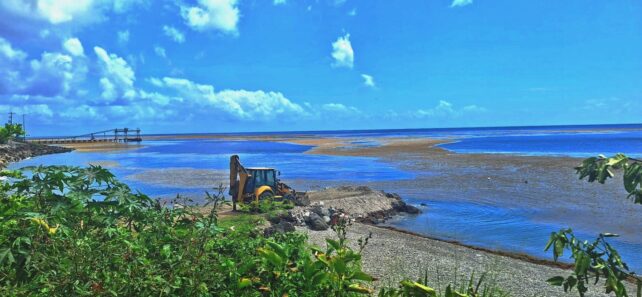
The Caribbean has been invaded by a record amount of Sargassum, commonly known as seaweed, in May and there is more to come a new study has shown.
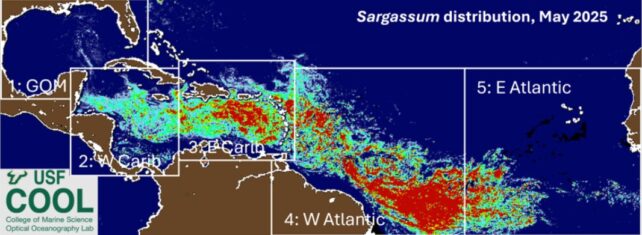
The study, which was released on Monday and conducted by the University of South Florida’s Optical Oceanography Lab, estimated that the region was affected by 38- million metric tons of the algae which is the biggest quantity since scientists began studying the Great Atlantic Sargassum Belt in 2011.
“As predicted last month, while the spatial distribution patterns of Sargassum remained stable, Sargassum amount in each region increased in May considerably,” the study said. “In every but the Gulf of Mexico region, Sargassum amount exceeded its historical record. In particular, total Sargassum amount from all regions combined further increased from 31-million tons in April to 37.5-million tons in May, making a new record.”
According to the study, there is more to come because as in previous years June is expected to see continued increases in most regions.
“More Sargassum is expected to be transported to the west Caribbean Sea and then to the Gulf through the Yucatan,” it pointed out. “Sargassum inundation will continue to occur in most of the Caribbean nations and islands as well as along the southeast coast of Florida.”
Brian Barnes, assistant research professor at the University of South Florida who worked on the study, told the Associated Press that Sargassum peaks are getting bigger every year.
“The peaks just seem to keep getting bigger and bigger year after year,” he said.
Scientists are baffled as to the exact cause of the increase of the seaweed growth with some pointing to climate change, fertilizer runoff and deforestation in South America as possible significant contributors.
“It’s the million-dollar question,” Barnes said. “I don’t have a supremely satisfying answer.”
He told the Associated Press that while large clumps of seaweed in the open ocean can create “healthy, happy ecosystem” for some sea creatures, it can create havoc when it hits shore or comes close to land.
He said the seaweed can block sunlight coral reefs need to survive, destroy other sea gases and cause a stinky mess when rotting.
“The smell is quite terrible,” Barnes stated.
While most Caribbean countries simply let the seaweed rot on shore or be taken away by ocean currents, authorities in the French islands are taking active steps towards dealing with it.
They will soon be using storage barges and special vessels that can collect tons of the seaweed everyday.
French Prime Minister François Bayrou acknowledged the severity of the problem, calling the seaweed an environmental and social nuisance.
“It disfigures our coasts, prevents swimming and makes life impossible for local residents,” he told reporters.
The article is very detailed and provides insight into the growing Sargassum situation in the Caribbean, helping readers understand the severity and challenges facing it.
Always complaining about he bounty given to us by the sea . Free fertiliser and also free biomass that can be used to produce industrial alchohol for use in power generation . The byproduct of that can be used as animal feed
But we rather complain about it instead