




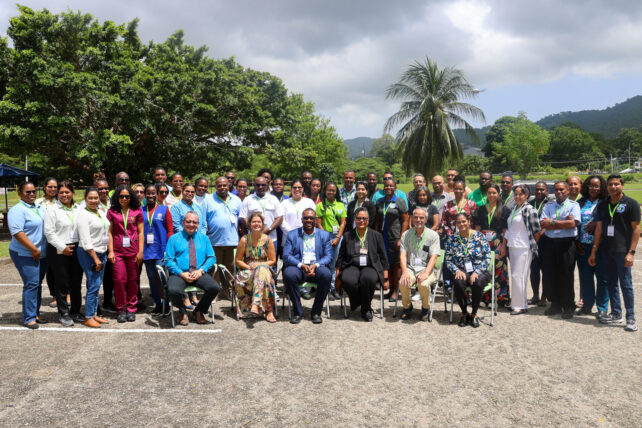
The Caribbean Public Health Agency (CARPHA), in partnership with the University of the West Indies (UWI) School of Veterinary Medicine located at St. Augustine, organized a three-day training session focused on the detection and monitoring of Culicoides (a.k.a’ biting midges’) and the hazardous Oropouche virus.
This event took place from August 4 to August 6, 2025, at the UWI School of Veterinary Medicine, within the Faculty of Medical Sciences at Mt. Hope, Trinidad and Tobago. A CARPHA press release said the goal of the workshop was to enhance the skills of 40 professionals representing 15 CARPHA Member States (CMS), including veterinarians, medical practitioners, and public health officials involved in vector surveillance and control efforts throughout the Caribbean.
Given what CARPHA states is the rising threat posed by Oropouche virus—a pathogen responsible for symptoms akin to dengue fever—building regional capacity in the identification, surveillance, and management of these insects has become increasingly vital, said the release.
The health organiation also acknowledged that due to the visual similarities among many Culicoides species and their common habitats, distinguishing between them can be challenging, complicating surveillance efforts and hampering regional health systems’ ability to prevent or respond to outbreaks. Therefore, training specialists and equipping them with the latest identification tools is crucial.
Dr. Lisa Indar, CARPHA’s Executive Director, highlighted the importance of the initiative: “Strengthening our capacity to identify and manage disease-carrying vectors is essential to safeguarding public health in the Caribbean. This workshop reflects CARPHA’s commitment to building regional resilience through science, collaboration, and training.”
Dr. Horace Cox, who oversees Surveillance, Disease Prevention, and Control at CARPHA, underscored the significance of the event: “This workshop marks an important step toward enhancing health security across our region. By improving our ability to identify and control vectors like Culicoides, we are better equipped to tackle threats such as the Oropouche virus and other emerging diseases. These skills are vital for protecting the health and well-being of our communities.”
“This program demonstrates our region’s capacity to develop specialized entomological expertise among professionals. Vectors like Culicoides spread diseases affecting livestock, such as bluetongue virus, and pose risks to both animals and humans—since their bites are painful and cause discomfort. Enhancing knowledge exchange among veterinary and health practitioners is fundamental to safeguarding human, animal, and environmental health sectors,” Karla Georges, Director of the UWI School of Veterinary Medicine at St. Augustine, also expressed the importance of the training.
The workshop reportedly featured both expert-led theoretical sessions and hands-on practical activities, including fieldwork at the UWI Field Station and a private farm in Santa Cruz. Participants learned about the biology, collection, transportation, slide preparation, and identification of Culicoides species, along with discussions on their significance for public health and control strategies.
Funding for this 2025 workshop was provided by the European Union through the 11th European Development Fund (EDF) Programme, aimed at supporting efforts against Zika and other mosquito-borne diseases.
For additional details on regional vector control initiatives, visit the Caribbean Vector Borne Diseases Network CariVecNet) at https://carivecnet.carpha.org/, the UWI School of Veterinary Medicine at https://sta.uwi.edu/fms/vet/, or the CaribVET Caribbean animal health network at https://caribvet.net/.
To stay updated on CARPHA’s work, follow them on Facebook, LinkedIn, and Instagram, or visit www.carpha.org. More information about the UWI School of Veterinary Medicine can be found at https://sta.uwi.edu/fms/vet/.
Disclaimer: The comments posted do not necessarily reflect the views of DominicaNewsOnline.com and its parent company or any individual staff member. All comments are posted subject to approval by DominicaNewsOnline.com. We never censor based on political or ideological points of view, but we do try to maintain a sensible balance between free speech and responsible moderating.
We will delete comments that:
See our full comment/user policy/agreement.