




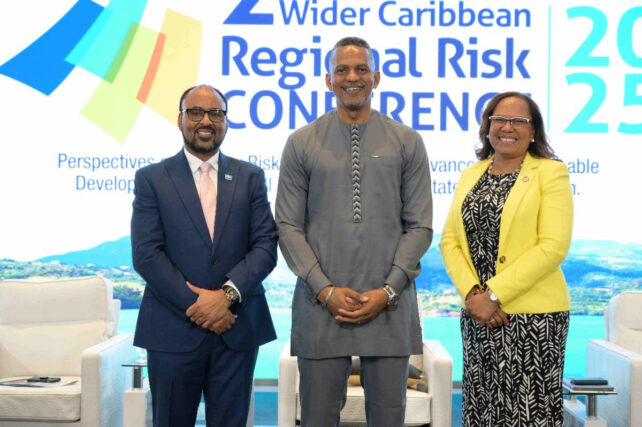
The President of the Caribbean Development Bank (CDB), Daniel M. Best, issued a call for the Caribbean region to move away from fragmented approaches and instead adopt comprehensive, cross-sectoral strategies to address what he identifies as the complex network of risks threatening sustainable development in the area.
During the 2nd Wider Caribbean Regional Risk Conference, hosted by CDB, CCRIF SPC—the Caribbean and Central America parametric insurance facility and development insurer—and CAF – Development Bank of Latin America and the Caribbean, Mr. Best emphasized that isolated responses are no longer sufficient.
He stated, “Fragmented responses are no longer viable. We cannot afford to respond to interconnected crises with disconnected strategies.”
He expressed concern that the combination of the climate emergency, economic instability, and social inequality is heightening the Caribbean’s vulnerability. To build resilience, he proposed a framework based on six key pillars: policy coherence, cross-sectoral collaboration, data-driven risk assessment, community participation, innovative financing mechanisms, and regional cooperation.
CDB reported that Best urged national governments to harmonize climate, economic, and social policies so that they support each other rather than conflict. He emphasized the importance of embedding disaster risk reduction, climate resilience, and social protection into national budgets, with scalable measures for times of crisis.
He also highlighted the necessity of breaking down institutional barriers, noting, “Ministries of finance, education, health, and environment must come together proactively before a crisis, in everyday planning and policy design.”
The role of data and technology in identifying vulnerabilities was another focal point. Mr. Best underscored that “what we cannot see, we cannot measure, and we therefore cannot solve,” calling for increased investment in geospatial data systems to enhance resource allocation and social protection targeting.
He also stressed the significance of local communities, describing them as “our greatest source of wisdom, resilience, and innovation,” and advocating for the integration of indigenous knowledge and grassroots expertise into policymaking. Regarding financing, he advocated for blended finance models, green bonds, and resilience-linked instruments to attract private sector investments while promoting fairness and justice. Recognizing that risks transcend borders, he called for stronger regional cooperation to pool resources and align policies.
Addressing the Caribbean Development Bank’s commitments, Mr. Best reportedly reaffirmed the institution’s support for its Borrowing Member Countries. He highlighted ongoing initiatives, including Climate Action programs, with 35% of all approvals planned for climate-related projects over the next five years. Within the USD 460 million Special Development Fund, the target is set at 40% for climate resilience projects. The Bank’s expanded Green Climate Fund accreditation now allows it to finance projects up to USD 250 million, facilitating larger-scale climate interventions and accelerating the region’s energy transition.
On economic resilience, the Bank stated that its new Private Sector Development Strategy aims to improve access to finance for Micro, Small, and Medium-sized Enterprises (MSMEs), women-led businesses, and export sectors. Innovations like the electronic Port Community System in Barbados are streamlining logistics and enhancing regional competitiveness.
For social inclusion, the company reports efforts include promoting gender equality and inclusive growth through initiatives like the Caribbean Gender Equality Market Sustainability Technical Assistance Project (Caribbean GEMS), the Basic Needs Trust Fund, and advanced poverty assessments that combine data and community participation to better target social support.
Mr. Best also pointed to reforms within the Bank itself to enhance risk management capabilities, including the Exposure Exchange Agreement to expand lending capacity and a new Enterprise Risk Management Framework to embed risk governance across operations. He affirmed that these measures reflect the Bank’s commitment to acting decisively against the pressing challenges faced by the region: “This is the role of your development bank, as a partner in transformation driving a pathway for a future-proofed Caribbean.”
The 2nd Wider Caribbean Regional Risk Conference, scheduled for September 3-4 in St. Philip, Barbados, convened governments, development partners, private sector stakeholders, and civil society to address the increasing interconnected risks confronting the Caribbean. The goal is to develop integrated strategies that bolster resilience and promote sustainable development.
Disclaimer: The comments posted do not necessarily reflect the views of DominicaNewsOnline.com and its parent company or any individual staff member. All comments are posted subject to approval by DominicaNewsOnline.com. We never censor based on political or ideological points of view, but we do try to maintain a sensible balance between free speech and responsible moderating.
We will delete comments that:
See our full comment/user policy/agreement.