




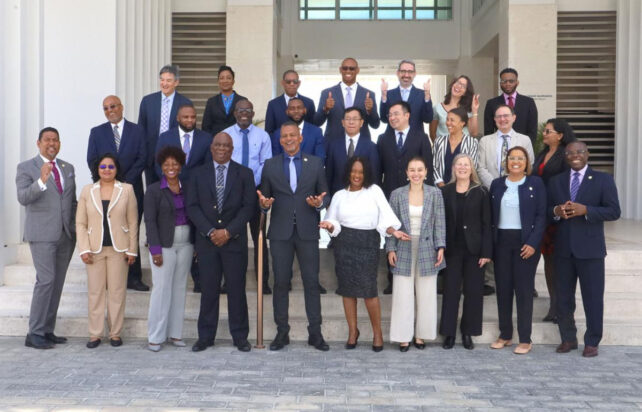
The Caribbean Development Bank has announced robust backing for the renewal of its flagship Special Development Fund for the 11th Cycle (SDF 11), scheduled to run from 2025 to 2028. Bank management shared via media release that the contributions will be from international and regional partners, with planned increases in commitments.
As the Bank’s largest source of concessional financing, the CDB said that the Fund plays an essential role in alleviating poverty and promoting human development across CDB’s Borrowing Member Countries (BMCs). Contributors have approved a total of US$460 million for SDF 11, marking a notable rise from the US$383 million allocated for the 10th Cycle, which concluded in December 2024.
The Bank reports that Canada, the leading contributor, has reaffirmed its support with a pledge of CA $81.4 million (US$59.9 million). Regional nations have also increased or maintained their contributions, demonstrating strong regional backing. Notably, Jamaica and Trinidad and Tobago have committed US$16.5 million and US$11.3 million, respectively, while the Bahamas and Guyana each plan to contribute US$9.2 million. Several other BMCs have enhanced their pledges, reflecting what CDB says is a collective commitment to advancing the region’s development goals. International and regional partners remain integral to this effort. China has pledged US$6.9 million, and Brazil announced a US$5 million contribution during the Brazil-CARICOM Summit last month in Brasília. Pledges from China and Guyana are subject to potential adjustments.
Expressing pride in the scale and importance of these commitments, CDB President Mr. Daniel Best stated, “At a time of global uncertainty and economic challenges, the commitment of our partners speaks volumes. Many have increased their contributions over the last cycle, demonstrating real confidence in the region’s potential and in the results we can achieve together.”
He further emphasized, “The Caribbean’s development needs are urgent. People across the region face daily challenges such as food insecurity, aging infrastructure, educational gaps, rising climate risks, and fragile energy systems. There is no time to waste. These funds will be deployed swiftly and effectively to address these critical issues.”
SDF 11 will prioritize building a more resilient and sustainable Caribbean. Its main focus areas include:
– Environmental Resilience: Allocating at least 35% of funds to climate action, covering sustainable energy, adaptation and mitigation efforts, disaster risk management, and recovery initiatives post-disaster.
– Institutional Resilience: Strengthening the capacity of BMCs to implement projects efficiently and effectively.
– Social Resilience: Supporting initiatives to improve social protection, education and training, food security, water and sanitation, and citizen security. The Basic Needs Trust Fund, CDB’s leading poverty reduction program, will continue to be supported.
– Production Resilience: Promoting private sector development and investing in resilient infrastructure to enhance economic competitiveness and sustainability.
Additionally, SDF 11 will reportedly include targeted assistance to Haiti, aiming to maximize development impact and foster long-term resilience.
“Since its inception in 1984, the SDF has invested more than US$2.1 billion in Caribbean social development. Between 2013 and 2022, SDF-financed projects enhanced education for more than 343,000 students, trained over 11,000 agricultural stakeholders in modern production technologies, improved road networks benefiting nearly 932,000 people, and provided more than 94,000 households with access to safe water and sanitation services,” reports the CDB.
Disclaimer: The comments posted do not necessarily reflect the views of DominicaNewsOnline.com and its parent company or any individual staff member. All comments are posted subject to approval by DominicaNewsOnline.com. We never censor based on political or ideological points of view, but we do try to maintain a sensible balance between free speech and responsible moderating.
We will delete comments that:
See our full comment/user policy/agreement.