




Editor’s note: The originl documents rcording the correspondence between Gov. Bell and Andrew Carnegie are attched at the botoom of the article.
I. The Discovery: A Window Into Empire, Education, and Philanthropy
History often advances through quiet acts—letters exchanged across oceans, ideas planted in the minds of strangers, small seeds that grow into mighty institutions. One such remarkable exchange occurred in the dawn of the twentieth century between Sir Hesketh Bell, the British Governor of Dominica (1899–1905), and Andrew Carnegie, the Scottish-American steel magnate turned global philanthropist. Their correspondence—an extraordinary “historical find”—reveals how Dominica, a small Caribbean colony, came to possess one of the most transformative institutions in its modern development: the Roseau Public Library, originally named the Roseau Free Library. Once my research discovered this treasure trove of correspondence of historic importance to our country, I felt compelled to share it with our people.
Carnegie, at the height of his philanthropic crusade to build public libraries throughout the English-speaking world, received from Governor Bell a persuasive appeal. Bell argued that Dominica, though impoverished by the collapse of its plantation economy, possessed a population eager for education and uplift. Carnegie—who believed that “the library outranks any other one thing a community can do to benefit its people”—responded generously. He offered funds for a library that would become one of only a handful of Carnegie libraries in the entire Caribbean.
Thus was born an institution that would alter the intellectual trajectory of generations of Dominicans. Its impact rippled far beyond the aspirations of its founders. For, among the thousands of children who walked its steps, inhaled the mingled scent of sea-spray and old books, and discovered there the world beyond our shores, were two boys who would grow into lifelong friends, scholars, authors, and nation-builders: Gabriel J. Christian and Irving W. André.
Their meeting in that library’s quiet research room would one day give birth to Pont Casse Press, a publishing house rooted in the intellectual soil nurtured by Bell and Carnegie’s visionary collaboration.
II. The Library on the Hill: Sea Breezes, Jalousie Windows, and the Education of a People
The Roseau Public Library stood as a handsome Caribbean bungalow—wooden, airy, perched atop a rise of earth and volcanic stone, just above the froth-flecked waves of the Caribbean Sea. Its wide verandas wrapped around the building. Large jalousie windows admitted the cooling breezes drifting from the Roseau Valley. It was a building designed not merely for the storage of books, but for learning to breathe in a tropical world—physically comfortable, intellectually invigorating.
For the Dominican child of the 1950s, 60s, or 70s, that library was a gateway to worlds unavailable in our schools. The modest libraries of the Dominica Grammar School or St. Mary’s Academy could not compare to the riches housed in the Carnegie institution: encyclopedias, world literature, periodicals from Europe and North America—The Economist, Newsweek, Time, and Illustrated London News. Its shelves held materials that allowed the curious mind to leap from Dominica to Moscow, London, Delhi, Havana, Lagos, or New York in a single afternoon.
It cultivated not just readers, but thinkers.
It nurtured independence of mind—essential in a society transitioning from colonial tutelage to self-government.
It birthed a Dominican intelligentsia.
And it was within this citadel of books, on one quiet Saturday around 1975, that a young Gabriel Christian noticed an older, slender, studious young man—Irving André of Portsmouth, then a senior student at the Dominica Grammar School—poring over a pile of texts in the small research section.
That moment began a friendship that would shape the cultural history of Dominica for decades to come.
III. A Friendship Forged in Books: Christian & André in the Roseau Public Library
Neither of us—Irving nor I—came to the Roseau Public Library by accident. Our households had been seeded with books, curiosity, and discussions on politics, empire, war, and the human condition. My father, Wendell McKenzie Christian, a veteran of the British Army’s South Caribbean Forces, maintained a love for Churchill and world affairs. At home were magazines, novels, and thick tomes such as The History of Civilization. In my brothers’ rooms were WEB DuBois, Che Guevara, Dickens.
Irving’s father, a highly educated customs officer, returned from Curaçao with a formidable personal library and a jazz collection that spoke to a cosmopolitan world. Books lined the walls of the André household, whetting young Irving’s appetite.
But the library—the Carnegie library—was where our worlds expanded in tandem.
We spent long Saturdays chasing knowledge we could not find in a colonial curriculum designed to create clerks rather than critical thinkers. In that reading room we wrote notes, debated ideas, discovered African liberation struggles, Caribbean history, Marxist theories, and the global currents shaping the independence movements then sweeping the Caribbean.
When the librarian announced closing time, we left reluctantly—our notebooks crammed with facts, quotations, and questions that carried us late into the night.
The Roseau Public Library became our university before university.
It armed us for intellectual combat.
It gave us language—political, historical, philosophical—with which to understand our island’s place in the world.
And years later, when we founded Pont Casse Press in 1992, we recognized that our publishing mission was, in a sense, a repayment of a debt—a debt owed to Governor Bell and Andrew Carnegie’s decision to invest in the minds of a small Caribbean people.
IV. From Library to Literature: The Road to Pont Casse Press
Our journey from library tables to publishing house was neither straight nor easy. The 1970s were a time of ideological awakening. As students, we founded study groups, produced newsletters, debated economics and socialism, and sought ways to lift Dominica from the long shadow of colonial neglect. After independence in 1978, our paths diverged academically—Irving to the University of the West Indies and later Johns Hopkins; I to the United States to study business, then law at Georgetown.
Yet the library remained our shared wellspring.
Even across borders, when Irving visited Washington, D.C., we returned to our old habits: devouring archives at the Library of Congress or the Martin Luther King Jr. Memorial Library, just as we had done in Roseau.
By 1992, our intellectual partnership matured into a publishing venture. With support from our wives—Kathy André and Joan Christian—we launched Pont Casse Press. Our first book, In Search of Eden: Dominica, the Travails of a Caribbean Mini-State, appeared in July 1992.
We dedicated ourselves to “making the record”—writing and publishing our history, literature, and political thought so that future generations would not wander in ignorance of their past.
By 2025, Pont Casse Press had published 44 books, an extraordinary output for an island of fewer than 80,000 people.
But in truth, Pont Casse Press began not in 1992, but in that magical small research room at the Roseau Public Library—conceived in the quiet turning of pages, the exchange of ideas, the shared hunger for knowledge.
V. Legacy of a Philanthropic Act: Libraries as Engines of National Development
The correspondence between Hesketh Bell and Andrew Carnegie was more than a bureaucratic request for funding. It was an act of faith—faith that education could transform a people, faith that a small island deserved the intellectual infrastructure of a great democracy.
Carnegie believed that access to knowledge was the surest path from poverty to progress.
He could not have known how profoundly his gift would resonate centuries later.
He could not have foreseen two Dominican boys—one destined to become a Canadian judge and author, the other an American attorney, historian, publisher, and civic leader—meeting in the quiet of his library and launching a project that would chronicle Dominican history with diligence and pride.
He could not have known that Pont Casse Press would emerge as a leading Caribbean publishing house, preserving our island’s memory, uplifting its heroes, and correcting colonial omissions.
Yet that is precisely what happened.
The Roseau Public Library stands as a testament to how a single philanthropic act—and one insightful governor’s advocacy—can shape the civic, literary, and intellectual destiny of a nation.
It is a reminder that the written word is the most powerful inheritance a people can receive.
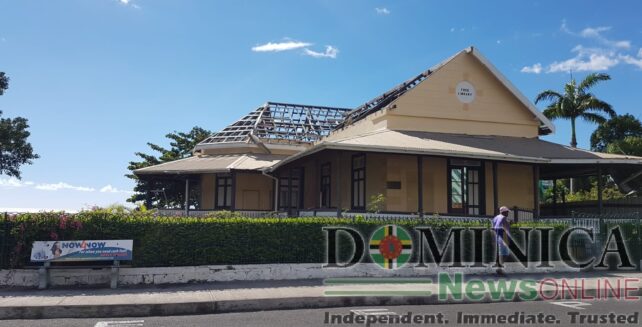
VI. A Call to National Mobilization: Rebuilding the Roseau Public Library After Hurricane Maria
No historical reflection on the Roseau Public Library can ignore the painful reality that this beloved Carnegie institution—once a sanctuary of learning and a cradle of Dominican intellectual life—lies in ruins today. Hurricane Maria in 2017 tore apart not only buildings and infrastructure but also one of the central pillars of Dominica’s educational and cultural heritage. The Roseau Public Library, which nurtured generations of readers, scholars, and visionaries, still stands shattered—its future uncertain, its spirit waiting for national resurrection.
This moment demands more than nostalgia; it requires mobilization.
The time has come for Dominicans at home and across the diaspora—educators, business leaders, civic organizers, architects, librarians, students, historians, and all those who once walked through its doors—to unite and rebuild this institution that shaped us. The descendants of those early seekers of knowledge, and the beneficiaries of Carnegie’s gift, must now step forward to renew that sacred trust.
The Government of Dominica must, without delay, endorse the formation of a bipartisan national steering committee—a coalition of civic leaders, educators, engineers, architects, business professionals, and diaspora representatives—to design, fund, and oversee the rebuilding of the Roseau Public Library. This must not be a partisan project, nor an occasion for political point-scoring. The library belongs to all Dominicans. Its rebirth must be a national cause, rooted in unity and guided by the belief that knowledge is the cornerstone of development.
We call upon the political opposition, private sector leaders, churches, trade unions, student groups, cultural organizations, neighborhood associations, and our vast diaspora networks to publicly join in this demand. Just as Dominica rebuilt after Hurricane David, and just as our ancestors rebuilt after fires, storms, and colonial neglect, we must now rally once more to rebuild the institution that rebuilt us.
It is heartening that organizations such as Rebuild Dominica Inc. (rebuilddominica.org) have kept faith with the mission of uplifting Dominican education. Their recent donation of US$5,000 worth of books to the Dominica State College demonstrates the diaspora’s enduring commitment to national renewal. They—and many others—stand ready to support this noble work.
To rebuild the Roseau Public Library is to rebuild our future.
It is to reclaim a vital space for children yet unborn, for students seeking opportunity, for writers and researchers shaping the next chapter of our national story. It is to honor the legacy of Bell and Carnegie, and to ensure that the gift they bestowed remains a living fountain of knowledge—not a memory crumbling under the weight of time.
Dominicans united have always achieved the extraordinary.
Let the rebuilding of the Roseau Public Library become our next great national achievement.
Conclusion: A Gift That Keeps Giving
Today, as Dominica continues to evolve, the legacy of Bell and Carnegie lives on in every Dominican who walked through the library’s doors, who discovered there their first passion for learning, who grew into teachers, lawyers, doctors, artists, historians, engineers, and leaders.
It lives on in the shelves of Pont Casse Press, in the books that now place Dominican voices in the global archive of human knowledge.
It lives on in the belief that no nation is too small to make a contribution to world civilization—so long as it commits to educating its people, recording its history, and telling its story with honesty, clarity, and pride.
The Roseau Public Library was more than a building.
It was a seed.
We—Irving André and Gabriel J. Christian—were among the many who blossomed from it.
And for that, we honor the amazing historical find: the correspondence that built a library, and in so doing, built us.
Original correspondence between Gov. Hesketh Bell and Andrew Carnegie:
This is very informative. The library shaped my foundation in so many ways. I was a little boy when my parents registered me and I have been an avid reader ever since. Thanks for the history.
Well, good research, we were colonized by these people, and it was brutal. Although it’s a new era with all said books a click away, we need desperately to get out of their grip. What you describe with the plethora of European authors and missionaries, in prep for conversion to europeanized culture disguised as education has little more than dumbed us down. It makes the case for reparations, return of all stolen resources from the unprovoked wars; exit from their commonwealth and full independence even more imminent.
The restoration of historical structures elsewhere in the world shows what is possible and how old skills can be revied in rebuilding.
Although on a different scale, the BBC documentary “A Country House Re-Born” (Available on YouTube) is an exemplary example of what can be done.
I hope that a restored Carnegie Library – in its original setting – and an exemplary new library in the town centre, will be our legacy for future generations.
A library is an essential space for nurturing independence of mind. Ii have such fond memories of the Rosesu library and the surrounding space. It should be an area of high priority in the development of our country.
How many years after hurricane Maria, somebody(ies) eyeing the area to expand southwards. Waiting for the right time to pounce on the property.
Gabriel, I too have spent hours at that very library and really appreciate how you and countless others continue to pass on these invaluable historical and cultural knowledge and lessons. You must be all commended for that. However, it’s time to move on. The previous library battered by two hurricanes no longer fits the purpose for which it was originally designed (even if it were still in use). A new library needs to be re-imagined with a new footprint. One that is resilient to future physical threats such as hurricanes but also offering air condition comfort. Also bearing in mind some material are better kept in a certain environment in terms of humidity. Whereas physical books have their place we also have to embrace technology and cater to users of the future. That “airy” nostalgia of decades past may have to be sacrificed for something practical, modern resilient and future facing. Yes, by all means lets preserve a section including photos so we never forget but lets move on.
Of course, a new library can be built at another location with all the modern amenities. But it is never a good idea to erase a country’s history. It would be a terrible idea to destroy the public library. Let its history live on so future generations can learn and enjoy….just as you did.
Not suggesting we destroy history at all. If you re-read, I advocated memorializing it somehow within the new building. Important to note though that meanwhile there is no full coverage public library adequately serving the public and what is left of the building remains an eyesore. The original building in question was destroyed by the hurricane. Government seem to be paralyzed about the decision going forward and that is not serving the public well. It has been 8 years with no expressed vision of what a modern future facing building will look like. So yes, by all means memorialize but lets move forward with ideas for a modern building.
All over the world, historical preservation is a high priority for the sake of history, tourism, and education….EXCEPT in Dominica. With so many educated people, one would think that this simple idea would be clearly understood. A new library is required at a different location. But the current library needs to be preserved, not memorialized.
Yes but…
As I stated in my DNO Commentary “The New Library: an alternative approach”
There are two separate and distinct issues involved: the preservation of an important historical building and the pressing need for a new purpose-built library. The restoration of the Carnegie Library should not be compromised by planting a new library within its grounds. A more suitable location for the new library can be found within Roseau’s city centre.
Well said.
I want to really endorse your comment. If that library is rebuilt in its original form or becomes simply a nostalgia project we will have failed future generations. What we do have the chance to do is to put in place a monument to our past but also a launch pad for the future reflecting what voluntary learning and knowledge storage should look like in the future. something which can be of benefit to leaners and researchers from Scots Head to Capuchin , Colihaut to the Kalinago Territory. I like the idea of a steering committee with a well defined terms of reference and a time limited objective.
In the short term the current structure should be demolished .. it is only a relic and a reminder of our lack of impetus and resilience. We don’t need the carcass.. we need a functioning entity doing for future generation what it did for ours
No we would not have failed anyone but you.
Gabe your commentaries always inform. Roseau library needs to be rebuilt; books are sure things to educate when tvs, computers and cell phones go silent.