




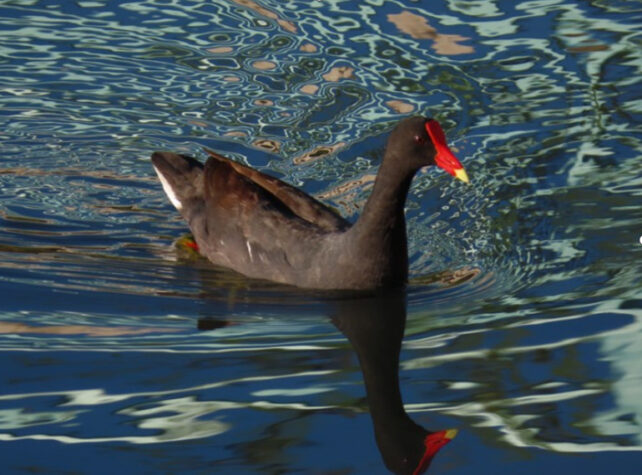
5:11 p.m., 12th April 2022
From 2004 up until recently Dominica annually joined several other Caribbean countries in the observance or celebration of the Caribbean Endemic Birds Festival (CEBF), which extended from 22nd April through 22nd May.
Dominica’s month-long programme for CEBF was possibly the most comprehensive among the participating countries, with an opening address by the Minister responsible for Forestry, Wildlife & Parks, school and public lectures, radio quizzes, BirdArt Exhibitions, publishing of media articles and other media activities, Whistle Like A Bird Contest, birding activities with school groups and hiking groups, Choral Speech competition, and a boat trip to Pointe Des Foux in the island’s deep south in order to view colonies of sea birds and roosting Yellow-crowned Night Herons.
Within the last few months, certainly from at least January of this year or before, persons commuting across the Dominica-China Friendship Bridge (a.k.a. the ‘Roseau Market Bridge’) or strolling near the western end of the Riverside Promenade have been doing their own bird-watching, in a casual and limited way as it were.
Persons looking over the railing along the seaward side of the bridge, or looking over the Promenade Wall near the bridge have noticed at least one bird swimming like a duck on the water or walking on the edge of the vegetation, and have referred to this bird as a duck. These mostly slate-black-and-brown birds are not ducks, but Common Moorhens (Gallinula chloropus) and locally they are known as ‘Poul glo’ and ‘waterfowl’. They do not have webbed feet, but instead have long, yellow, striped toes but are able to move smoothly through the water… like a duck.
The Moorhen is a resident species of bird and not a migrant, and at least three of them – two adults and one immature – have recently made the Roseau River estuary their home. Occasionally, the trio have been photographed together.
Persons taking boat trips up the Indian River often encounter at least one or a pair of Moorhens walking along the edge of the river or swimming. They were also encountered on many occasions on the Matthieu Lake when that body of water was in existence, at the Cabrits Swamp, and elsewhere on the island.
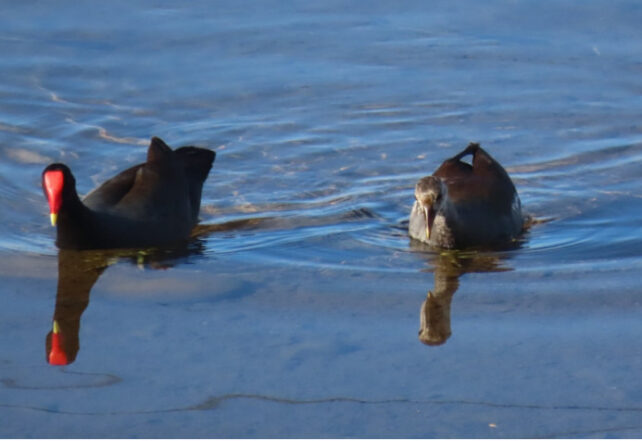
On 27th January and 14th February 2022, one of the adults was observed making several trips, swimming with long, dried blades of grass in its bill and delivering each piece to the other adult (possibly the female) who was fixing the material into a nest that the pair was constructing. But the status of that nest is unknown, as to whether it was ever completed. Moorhens can build several nests in one area during a nesting season.
On two other occasions the adults were also observed mating, on 4th February (5:07 p.m.) and on 20th March (6:30 p.m.). On the second occasion the male was observed to pass his foot over the back of the female before mounting; this happened three times within about a minute.
Adults are monogamous, i.e. they have only one partner at a time, and the female can lay from 4 to 12 eggs in a clutch. So, who knows, we just may have a small resident population of Poul Glo near the mouth of the Roseau River over the next few years.
So, the next time that you are crossing that bridge or walking near the end of the La Promenade River Wall, take a look down below. You just may see one, two or all three Moorhens. If an adult is out of the water, look for the yellow legs and feet, and the bright red band above each knee joint just below the feathers. Of course, the distinctive, brilliant red face shield between the eyes of the adults cannot be missed. Note too that the red of the face shield extends to about two-thirds the length of the bill (beak) which has a yellow tip. The red of the face shield appears as the juvenile matures.
One other bird which may have been observed recently while crossing the “Market” Bridge is the Black-crowned Night Heron (Nycticorax nycticorax).
This bird, whose plumage is black-grey-and-white with a long white plume, can be considered to be a rare migrant visitor to Dominica and is presumed to be on its north-bound migration back to North America at this time.
Retired Forestry Officer Bertrand Jno. Baptiste, one of Dominica’s foremost authorities on birds, disclosed that in his many years of birding he had only seen that species on Dominica on two prior occasions – including Layou River.
The Black-crowned Night Heron – also called the Black-capped Night Heron –– is a close relative of one of the largest of our local birds, i.e. the Yellow-crowned Night Heron (Nyctanassa violacea). Dominicans know the ‘Yellow-crowned’ by the local names of Kwabyé jenga and Kwabyé sann.
Sightings of the Black-crowned Night Heron were made by the author on four evenings between the last week of February and the first week of April: on 23rd February, 1st March, 28th March (that evening two birds sighted simultaneously, one on either side of the river at about 6:20 p.m.) and 4th April. Some commuters disclosed that on occasion they have observed one of these birds in the estuary between 5:30 o’clock and 6:30 on some mornings.
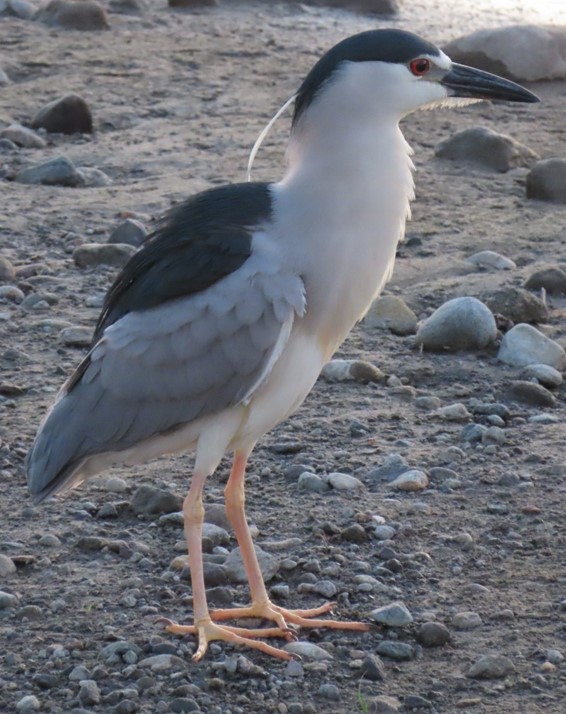
The natural range of the Black-crowned includes several states within the USA, a small part of Canada, and many South American States. According to TheCornelLab’s ALL ABOUT BIRDS, the Black-crowned Night Heron is described as a “Resident to medium-distance migrant. Some populations stay in one place year-round, while others disperse short distances of 5–60 miles. Others migrate farther, such as from Massachusetts to Florida and the Caribbean, or from Alberta (Canada) to Mexico and Cuba. (North American) migrants follow the coast or the Mississippi River flyway.”
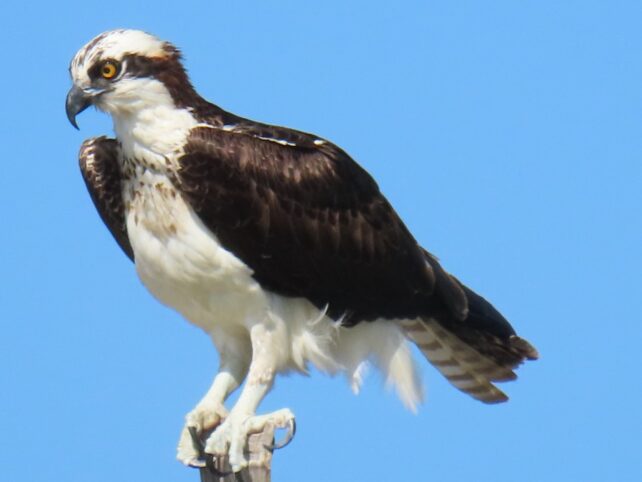
In addition to the Magnificent Frigate Bird (sizo), Laughing Gull (mayéga), Royal Tern, Pelican, Green Heron (kalali), Zenaida Dove (toutwèl), Eurasian Collared Dove, Yellow Warbler (titin), Cattle Egret, Little Blue Heron (Kwabyé nwè), Yellow-crowned Night Heron, several other species of birds have been sighted in that area of the Roseau River. Migrating Ospreys (malfini lanmè), Belted Kingfisher (gad-layvyè), Great Blue Heron, Great Egret, multiple species of sandpipers (bégas) and other migrants are also sighted there on their south-bound then north-bound migration journeys.
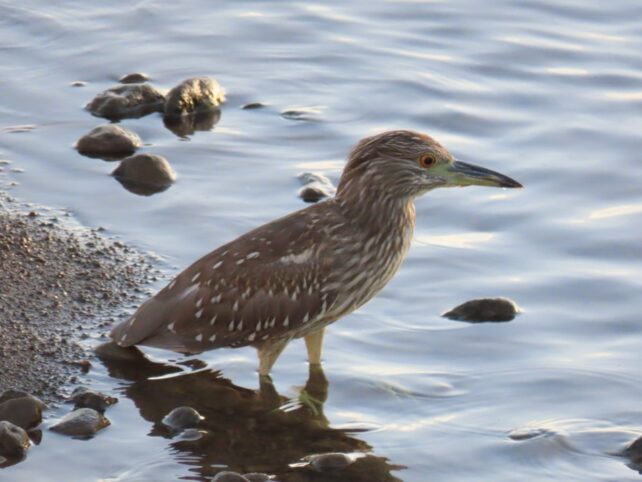
So, why not equip yourself with a pair of binoculars, a camera with a zoom lens, a copy of the Dominica’s Birds book available at the Forestry, Wildlife & Parks Division and go birding by the La Promenade or near the Roseau Market, or from the Dominica-China Friendship Bridge. Oh, and you’ll need a bit of time and patience. It will be a worthwhile, enjoyable experience.
That’s a great read. I always look out for those red faced bird’s on my walks past that bridge. It’s just unfortunate how the east side has such a dark murkey buildup from the sewerage runoff, KFC and all the others could find a way to dispose of the old oil or whatever it is that’s coming from there making the water so black and disgusting.
Thank you”Ti Nhomme” for another very interesting and relevant piece of knowledge about the world around us. Keep them coming
J,
Just adding my little ti-kapa..
A
Quite fascinating and very valuable information from the indefatigable Mr Arlington James. A veritable mimi bird sanctuary and hotspot may well be in the making there at the Roseau river to allure both locals and visitors alike. But will these magnificent birds escape the predatory machinations of would be hunters? The forestry must ensure their survival and proliferation.
Nice read………well appreciated.
Nice article Mr. James!
Interesting! That is enlightening and educational.
A nice detour from the many negatives.
Hope you all read this article and wish the author best wishes
I didn’t know Dominica has osprey birds. Thanks, Mr. James, for your informative article.
The osprey is not a bird that resides here.
They pass through twice a year. On their south bound migration, the on the north bound migration. The one in the photo nI shot on Christmas Eve.