




All views and claims expressed in this article are solely those of the author and have not been independently verified by Dominica News Online.
Few institutions in post-independence Dominica so powerfully embodied the struggle for national consciousness, cultural pride, cooperative economics, literacy, Pan-African solidarity, and people-centered development as the Frontline Cooperative Bookstore.
Founded in the early 1980s by a generation of young Dominican idealists, activists, teachers, writers, cultural workers, and returning diaspora patriots, Frontline was far more than a place where books were bought and sold. It was a school without walls, a people’s university, a cultural center, a cooperative enterprise, and a national consciousness movement.
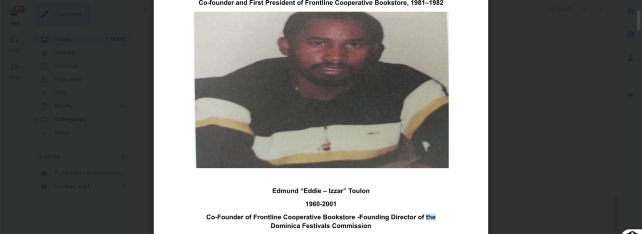
At the heart of that movement stood Edmund A. “Eddie” “Izzar” Toulon, a cultural nationalist of rare energy, vision, and commitment. Eddie’s life and work represented the finest traditions of Dominican self-help, Pan-Africanist thought, cooperative economics, and cultural nation-building. He walked in the spirit of Marcus Garvey, Edward Oliver LeBlanc, J.R. Ralph Casimir, Rosie Douglas, the maroon freedom fighters, and the generations of Dominican patriots who believed that true independence required more than a flag, an anthem, and a constitution. It required a liberated mind.
The origins of Frontline Cooperative Bookstore may be traced to a meeting held on March 1, 1981, following Eddie Toulon’s return to Dominica from the United Kingdom.
Eddie returned not merely as a migrant coming home, but as a young man shaped by Black British activism, Caribbean community organizing, African liberation thought, music, social work, and an urgent desire to contribute to the development of his native land. At that meeting were Eddie Toulon, Sonny Felix, Alvin Bertnard, and Gabriel Christian.
The early impetus for Frontline arose from the circles associated with Cadre Number One, also known as the Sisserou Youth Movement, the Roseau branch of the Popular Independence Committee led by Rosie Douglas and Sonny Felix. That movement, in turn, drew from the broader streams of Dominican nationalism, Pan-Africanism, Black consciousness, socialist-oriented development, and anti-colonial thought that animated much of the Caribbean in the 1960s, 1970s, and early 1980s. Of the four persons at the first meeting that formed Frontline, three had been members of Cadre Number 1: Alvin Bernard, Sonny Felix and Gabriel Christian. I had been introduced to Eddie when he returned from the United Kingdom by Maurison “Momo” Thomas, a St. Mary’s Academy graduate and the son of Superintendent of Police Tyrell Thomas. It is noteworthy that some of the most radical students of the 1970s were sons of people connected to the police or security establishment.
Frontline’s founding generation believed that political independence without mental liberation would leave Dominica vulnerable to neo-colonial dependency, class prejudice, racial insecurity, and foreign domination of the commanding heights of the economy. They believed that people who did not know their own history could not effectively control their own future. Culture, literacy, numeracy, poetry, music, history, and cooperative enterprise were therefore understood not as luxuries, but as instruments of national liberation and development.
From the outset, Frontline stood for pride in African and Kalinago heritage, support for African liberation movements such as the African National Congress (ANC) and the South West Africa People’s Organization (SWAPO), opposition to racism and color prejudice, and the promotion of a Dominican economy controlled by and for the benefit of the Dominican people. The founders opposed the colonial conditioning that had taught many Dominicans to prefer foreign approval over national dignity, imported models over local leadership, and class privilege over popular advancement.
The first President of Frontline Cooperative Bookstore was Gabriel J. Christian. The General Secretary and Bookstore Manager was Edmund A. “Eddie” “Izzar” Toulon. Together with a remarkable body of committed members and supporters in Dominica and the United Kingdom, they created an institution whose motto captured its mission with enduring clarity: “Knowledge Conquers All.”
Edmund A. “Eddie” Toulon was born on May 9, 1960, at the Princess Margaret Hospital in Roseau, Dominica. He was the son of Inspector of Police Edmund Toulon and Marvlyn Toulon. He grew up in a family rooted in discipline, public service, education, and community responsibility. His siblings included Sandra, Connie, Paula, and Brian, also known as Larry. In later life, Eddie was married to Blanche Toulon, and he was the father of two sons, Tyrone and Yohan, and two daughters, Kimara and Gem.
Eddie began his primary education at the Roseau Boys School in Roseau. His secondary education began at Saint Mary’s Academy, one of Dominica’s leading educational institutions. He later migrated to the United Kingdom, where he attended an Inner London Education Authority school in West London before moving on to Hammersmith and West London College. There, he studied business and Black History
studies.
His years in Britain were decisive. West London in the 1970s and early 1980s was a vibrant arena of Caribbean migration, Black cultural resistance, anti-racist activism, Pan-Africanist thought, reggae music, community education, and working-class organizing. Eddie absorbed the lessons of that environment. He understood that Black communities in Britain were fighting not only for jobs and housing, but also for dignity, history, and self-definition.
Upon completion of college, Eddie worked as a social worker in the North Paddington community of London. That experience brought him into close contact with Caribbean and African youth, working families, and communities struggling against racism, poverty, exclusion, and alienation. It strengthened his belief that education and cultural identity were necessary tools for empowerment.
During that same period, Eddie was also deeply involved in music. He was lead vocalist with a musical band called Samaritans and was also associated with Inity Rockers, performing at clubs, colleges, and community events throughout London. Music, for Eddie, was not separate from liberation. It was part of the same movement of consciousness that included books, poetry, history, and community organizing.
When Eddie returned to Dominica in 1981, he brought with him the knowledge, confidence, and international connections gained from his years in Britain. He rejoined his family and immediately set about helping to establish a London-linked educational project that became Frontline Cooperative Bookstore, which opened in 1982.
Frontline began humbly. The early effort was supported by British progressives, Dominican diaspora activists, and community-minded persons who saw the need for a bookstore that would serve the intellectual and cultural development of the people. Its early stock began with two tea chests of books. From those modest beginnings, Frontline developed into one of the most important cultural institutions in Dominica.
The bookstore was located at Queen Mary Street in Roseau and became known as an alternative bookshop. It provided access to Afro-Caribbean, African, Latin American, Black progressive, Third World, and local Dominican literature. It stocked books that taught Dominicans about themselves, their African ancestry, their Kalinago heritage, their Caribbean identity, and the struggles of oppressed peoples across the world.
Frontline rejected the narrow idea that a bookstore should exist only for personal profit. It was built upon the cooperative spirit. Its purpose was to serve members and the wider community. It sought to uplift literacy standards, provide affordable books, promote local writers, and create employment and training opportunities. It evolved into a bookshop, cultural center, music outlet, photographic service, printing operation, publishing house, and promotional agency.
The early stalwarts of Frontline included Eddie Toulon (Frontline Cooperative Bookstore Manager), Gabriel Christian (the first President), Steve “Nii Kwashi” Roberts (the second President), Milton Eloi (the third past President ), Curtis Victor, Bevin Lewis, Alvin Bernard, and Darwen Daway. These names deserve to be inscribed in the annals of Dominican cooperative and cultural history.
The wider membership of Frontline also included: Jill Selbourne of Frontline U.K., Jen McCleland of Frontline U.K., Andy Gregg of Frontline U.K., Sandra Casimir, Harold Sealy, Delmance Moses, Esther Henderson, Marina Issacs, Christopher Bannis, Loftus Emmanuel, Gairy Williams, Jo-Anna Terrell, Isaline Carter, Jane Deeks, Jonathan Deeks, Cynthia Joseph, Cuthbert George; Allan Browne, Michael Anselm, and Calicharan James.
The Board of Directors during Frontline’s tenth anniversary period included Alvin Bernard as President, Melvyn Didier as Treasurer, Frank Jno. Baptiste as Vice President, Zenith Jean Jacques as Assistant Secretary/Treasurer, Bevin Lewis as Board Member, Emmanuel Prince as Board Member, Edmund Toulon as Secretary/Manager, and Washbourne Cuffy as Business Advisor.
The Frontline family also extended to supporters, donors, agencies, and allies who helped sustain the institution, including the Nuffield Foundation in the United Kingdom, Christian Aid, the Lord Ashdown Foundation, USAID, The Law Offices of Gabriel J Christiasn & Associates, LLC, Pont Casse Press, the Cooperative Division of the Government of Dominica, the Small Project Assistance Team, the Cultural Division, the Dominica Credit Union League, the National Commercial Bank, the Government of Dominica, Nature Island Studio, J. Astaphan & Co. Ltd., Mussons Travel, Laurents Trading, Dominica Broadcasting Studio, Lennox Honychurch, Anthony Lockhart, Alwin
Bully, and many other patrons and community supporters.
The role of Frontline U.K. was especially important. Jill Selbourne and other British-based supporters helped provide books, training, funding links, and institutional support.
Through the Nuffield Foundation, Christian Aid, and other progressive networks, Frontline established an international bridge between Dominica and the Black and progressive communities of Britain.
The philosophy of Frontline was explicitly Pan-Africanist and people-centered. The bookstore’s shelves reflected a deliberate choice to provide literature by and about African, Caribbean, Latin American, and Third World peoples. It did not merely sell books; it challenged colonial narratives. It invited Dominicans to see themselves as historical actors rather than passive subjects of European conquest and colonial
administration.
This was why the writings and publications associated with Frontline placed strong emphasis on the falsehoods of colonial discovery, the survival of the Kalinago people, the brutality of enslavement, the resistance of maroons, the importance of African liberation movements, and the responsibility of citizens to build a just and equitable society.
Rampart magazine became one of Frontline’s most important cultural contributions. The name Rampart suggested defense, resistance, and barrier-breaking. Through Rampart I, Rampart II, and Rampart III, Frontline gave voice to Dominican poets, essayists, artists, and thinkers. It created an independent platform where national history, cultural pride, social criticism, and literary experimentation could flourish.
The writings in Rampart revealed Frontline’s philosophy. Essays such as “Did He Discover?” and “How Columbus Crumble Us” challenged the colonial celebration of Columbus and forced readers to confront the violence inflicted upon indigenous peoples. “Focus on Education” treated education as a national development priority.
“Women in Development” recognized the role of women in the advancement of society. The inclusion of “The Freedom Charter: Vision of a People’s South Africa” affirmed solidarity with the African National Congress and the South African liberation struggle.
Poems such as “Frontline,” “True Love for National Construction,” “Dominica,” “Tribute to Caribbean Greats,” and “The New Order?” reflected a worldview grounded in resistance, patriotism, social justice, and cultural affirmation.
The poetry and essays of Rampart must be understood within the ideological framework that shaped Frontline from its outset. They were not isolated literary exercises. They were part of a project of consciousness raising. They sought to free the Dominican mind from inferiority complexes, colonial myths, class prejudice, racial insecurity, and intellectual dependency. They affirmed that the people of Dominica had their own heroes, their own culture, their own creative genius, and their own right to define development in their own interest.
Frontline’s work also embraced popular culture. Under Eddie Toulon’s leadership, the bookstore expanded into music and cultural promotion. From 1988 to 1992, Frontline was involved in major promotions featuring regional and internationally acclaimed artists such as Gregory Isaacs, Culture, Burning Spear, Bunny Wailer, Dennis Brown, Chalkdust, Shadow, Maxi Priest, and others. These events were not merely concerts.
They were cultural gatherings that connected Dominica to the wider Caribbean and African diaspora.
Frontline also developed photography, silk-screen printing, and promotional services. Its black-and-white photography documented national events, historic scenes, and community life. Its silk-screen printing promoted local and Caribbean themes, including the “Caribbean Heroes” project, which highlighted great personalities of the region.
These activities showed that Frontline understood culture as a productive sector and as a tool of education. The cooperative also engaged in cultural exchange. The 1988 “Vwa Dominik” tour to London, organized in the context of Dominica’s tenth independence anniversary, brought Dominican performers to migrant communities and wider West Indian audiences in Britain. It represented a powerful bridge between homeland and diaspora.
Frontline was therefore a practical expression of nation-building through cooperative economics. It showed that young Dominicans could pool resources, acquire training, build an institution, own property, create services, employ people, and contribute to national development. Its evolution from a small rented space to an improved facility owned by the society was itself a symbol of collective effort and self-reliance.
As President Alvin “Alo” Bernard later observed, Frontline became a monument to the virtues of cooperation and hard work. It grew from a tiny room in the basement of a building connected to Loftus Emmanuel into a facility intended to house a bookshop, darkroom, printshop, and research library. Its future plans included music production and book publishing. It also contributed to schools, voluntary organizations, non-profit bodies, cultural exchanges, and the national scholarship fund.
That sense of community responsibility was central to Frontline. It donated prizes to schools and charitable organizations, including a significant contribution to the Education Trust Fund in 1990. Its members came from journalism, teaching, law, policing, banking, insurance, project management, and other professions. The cooperative was a gathering place for progressive men and women who believed that citizenship required service.
The intellectual genealogy of Frontline stretched backward and forward. It drew inspiration from J.R. Ralph Casimir and the Marcus Garvey -led Universal Negro Improvement Association, from the Movement for a New Dominica, from Cadre Number One, from the Popular Independence Committee, and from the wider Pan-African and socialist movements that demanded African liberation and Caribbean self-
determination.
It also pointed forward. When Gabriel J. Christian later went to the University of the District of Columbia to study Procurement and Public Contracting, and then joined with former Cadre Number One member and Johns Hopkins University Ph.D. student Dr. Irving W. André to form Pont Casse Press in 1992, that publishing venture represented in many ways a continuation of Frontline’s work. Pont Casse Press carried forward the mission of consciousness raising, popular education, historical recovery, and the publication of Dominican scholarship.
Thus, the line of continuity is clear: Garveyism, J.R. Ralph Casimir, the Movement for a New Dominica, Cadre Number One, the Popular Independence Committee, Frontline Cooperative Bookstore, Rampart magazine, and Pont Casse Press all belonged to a broad tradition of Dominican intellectual resistance and nation-building. In that tradition, Eddie Toulon occupies a place of honor.
After his years of leadership at Frontline, Eddie carried his talents into wider public service. In 1992, he was elected the first Chairman, or Mayor, of the Canefield Urban Council. He served two consecutive three-year terms ending in 1998. During his tenure, he also served as President of the national local government authority. His work in local government reflected the same principles that animated Frontline: community development, participatory leadership, and practical service.
Eddie also served as Chairman of the National Education Trust Fund Committee, continuing his deep commitment to education as a foundation of national progress.
In 1997, he became the first Executive Director of the newly established Dominica Festivals Commission. In that role, he organized, promoted, marketed, and helped distribute the arts and culture of Dominica through major national events including Mas Dominik, Domfesta, the National Exposition, and most notably, the World Creole Music Festival.
The World Creole Music Festival was one of Eddie Toulon’s great achievements. It emerged as a flagship event for Dominica and became a major tourist attraction. More importantly, it affirmed Dominica as a center of Creole culture. It celebrated music, language, food, dance, identity, and regional solidarity. It connected Dominica to the French Caribbean, the wider Caribbean, Africa, Europe, and the diaspora.
The World Creole Music Festival was the national flowering of ideas Eddie had long nurtured at Frontline. The same young man who had once stocked Afro-Caribbean and Black progressive literature, promoted reggae and calypso artists, and organized cultural exchanges was now helping Dominica use culture as a pillar of national development.
Eddie understood that culture was not decorative. It was infrastructure. It was the architecture of belonging. It was a way for a small island nation to stand tall in the world. Besides music, culture, and tradition, Eddie loved cricket, football, fast cars, and travel. He was known for his warmth, humor, energy, generosity, and ability to bring people together. He was a man of open hand and open heart. Tragically, on October 2, 2001, Edmund A. “Eddie” “Izzar” Toulon died suddenly following a severe and fatal asthma attack. He was only forty-one years old. His death shocked the nation.
Dominica responded with a massive and tearful send-off. Thousands turned out in Roseau to pay their final respects. Schoolchildren lined the streets as the hearse made its way from the Frontline Bookstore, where his body was viewed by the public, to the Cathedral of Our Lady of Fair Haven, and then to the Roseau Catholic Cemetery. There he was laid to rest alongside his deceased parents.
At his funeral, Gabriel J. Christian described Eddie as a fallen giant of the national forest: “A big Gommier tree in our national forest has fallen.” It was a fitting image. Eddie had sheltered many. He had given shade to young writers, artists, musicians, activists, students, and ordinary citizens seeking encouragement. He had nourished a movement of cultural pride and national service.
He left to mourn his wife, Blanche Toulon; his sisters Sandra, Connie, and Paula; his brother Brian, also known as Larry; his sons Tyrone and Yohan; his daughters Kimara and Gem; and many relatives, friends, colleagues, artists, writers, cultural workers, and citizens who had been touched by his life.
Yet Eddie Toulon did not leave behind merely memories. He left institutions. He left Frontline. He left Rampart. He left the example of cooperative economics. He left the World Creole Music Festival. He left a model of cultural leadership. He left proof that young Dominicans, organized around ideas and service, could build institutions of lasting national significance.
His legacy lives on in the consciousness and love of country he inspired. It lives on wherever Dominican children are taught to value their African and Kalinago heritage. It lives on wherever local writers publish their work. It lives on wherever Creole culture is celebrated with dignity. It lives on wherever cooperative economics is used to uplift the community. It lives on wherever Dominicans reject inferiority and embrace the power of their own history.
The story of Eddie Toulon and Frontline Cooperative Bookstore is therefore not simply the story of a bookstore or one remarkable man. It is the story of a generation that believed Dominica could be remade through knowledge, culture, cooperation, and justice.
It is the story of books as weapons against ignorance.
It is the story of music as liberation.
It is the story of poetry as nation-building.
It is the story of cooperative economics as self-determination.
It is the story of cultural rendition as an act of freedom.
Frontline taught that a nation cannot be built merely by roads, buildings, budgets, and elections. A nation must also be built in the mind, in the imagination, in the schoolroom, in the bookstore, in the poem, in the song, in the cooperative, in the memory of ancestors, and in the confidence of its people.
That was Eddie Toulon’s great lesson.
That was Frontline’s enduring gift.
On or about September 1, 2010, Frontline closed its door despite the valiant efforts of Harold Sealey and Zenith Jean-Jacques to keep it open. It has lasted 29 years as an organized voice of Dominican literature and cultural rendition in the pursuit of national liberation.
And that is why, decades later, the motto still speaks with undiminished power:
Knowledge Conquers All.
Disclaimer: The comments posted do not necessarily reflect the views of DominicaNewsOnline.com and its parent company or any individual staff member. All comments are posted subject to approval by DominicaNewsOnline.com. We never censor based on political or ideological points of view, but we do try to maintain a sensible balance between free speech and responsible moderating.
We will delete comments that:
See our full comment/user policy/agreement.