




Disclaimer: The views expressed in this article are solely those of the author and do not reflect the views of Duravision Inc, Dominica News Online, or any of its subsidiary brands.
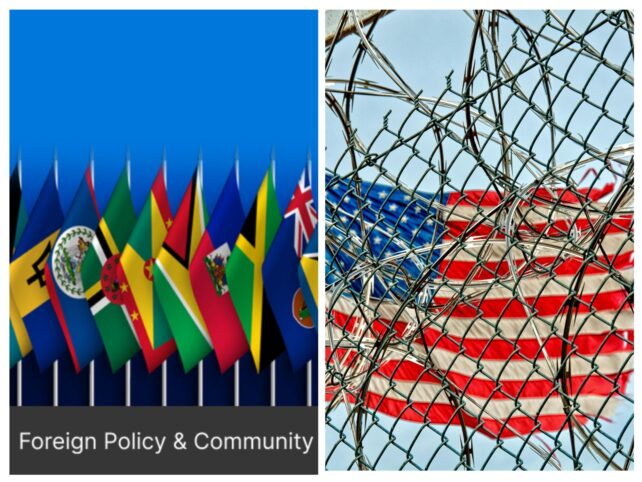
The 14 sovereign Caribbean Community (CARICOM) member states have struggled to collectively mount a coherent foreign policy response to the U.S. military’s now months-long surge into the Caribbean, unfolding under the aegis of “Operation Southern Spear”.
Dissension has surfaced within this bloc’s ranks, with the fractious nature of associated intrastate relations recently coming to light.
Conspicuously, Trinidad and Tobago has pursued a radical break with many of its sister CARICOM member states’ respective foreign policy stances on “Operation Southern Spear.”
As I contend in an article published in the December 11 edition of the Trinidad and Tobago Guardian, this operation is emblematic of America’s hegemonic stratagem for the Western Hemisphere.
The foreign policy-related differences arising do not just pit Trinidad and Tobago against virtually all its sister CARICOM member states, though.
Guyana has come out in support of U.S. power projection in the Caribbean, at a juncture when Washington is leaning in “to strengthen and expand Guyana’s strategic partnership with the United States.”
U.S. Secretary of State Marco Rubio also recently signalled Jamaica is among a group of countries in the Caribbean Basin that — inclusive of Guyana and Trinidad and Tobago —”openly cooperate with [the United States].”
Indeed, a recent development in U.S.-Jamaica relations is on the radar of analysts. Namely, and with little by way of public messaging on the engagement, high-level Jamaican and U.S. delegations met in Kingston on December 11.
On December 27, in his capacity as outgoing CARICOM Chair, Jamaican Prime Minister Andrew Holness sounded an optimistic tone about the regional grouping’s accomplishments in recent times. That said, under his watch, the bloc’s balancing act regarding the regional and national interest took a hit from Trump 2.0.
Accordingly, Holness cautioned his regional counterparts that “[t]he current international environment requires our Region to act with clarity, cohesion, and strategic discipline.”
This viewpoint adds a fresh layer to the concern of CARICOM insiders that differences among member states over “Operation Southern Spear’ will likely not be the last test of CARICOM unity vis-à-vis Trump 2.0.
This is the price of CARICOM member states’ competing foreign policy dispositions in respect of Trump 2.0.
In 2026, given a shifting balance of interests, the bloc has its work cut out for it in dealing with Washington in foreign policy terms.
Insofar as uncertainties about the U.S.-facing foreign policy road ahead loom large, the next CARICOM summit could potentially be a crucial factor in efforts to grapple with the harsh realities that have beset this bloc since this past September.
Member states and the regional grouping’s principal administrative organ — i.e. the Guyana- headquartered CARICOM Secretariat — will have to bring pertinent diplomatic channels at their disposal to bear on the situation.
Barring such a sustained effort, the summit may well fall short on the above-stated outcome.
Even if all goes to plan beforehand, this summit may not necessarily help to turn the corner on deep-rooted foreign policy divisions.
Such a scenario would only increase the diplomatic cost that already looms large over CARICOM, weighing down the bloc and aspects of its international relations with third parties.
All eyes are on the summit in question, scheduled to be held early in the new year.

Nand C. Bardouille, Ph.D., is the manager of The Diplomatic Academy of the Caribbean in the Institute of International Relations at The University of the West Indies (The UWI) St. Augustine Campus, Republic of Trinidad and Tobago. The views expressed are those of the author and do not reflect the official policy or position of The UWI.
ANOTHER CARICOM SUCCESS STORY!
The CARICOM Election Observer Mission (CEOM) is a praiseworthy and essential initiative for the Caribbean electorate and may very well have made a difference in the recent St. Vincent election. The next natural step is a WBD (WhistleBlower Desk) within the Secretariat where patriotic Caribbean citizens can safely and anonymously report provable incidences of waste, abuse and corruption by unscrupulous politicians. If we can guarantee investors that our politicians will not unduly interfere in the management of our financial and other public institutions, the Caribbean will be a panacea for investment, especially among the Diaspora.
But the rewards will be positive only if all the regional institutions actively participate.
Read chapters 1 and 15
https://www.amazon.com/dp/B0DJ3SYZPJ
So, what really is “the price of CARICOM countries’ competing foreign policy dispositions?” The answer is buried somewhere in that commentary, DNO. I still lookin for it.
Not impressed.
THE CARICOM ELECTORATE
What’s wrong with us in the Caribbean?
Most free nations from distant parts of the world are trying their best to be friends and cooperate with the US. For instance, look at what transpired recently: two countries all the way from Africa, at war with each other for decades, surprisingly chose the US to announce their historic Peace Treaty.
But mysteriously, we in the Caribbean, next-door neighbors to the most powerful country on earth, are desperately trying our very best to be their enemies. Whom would we rather have on our backyard, the USA or autocratic regimes which suppress all Human Rights and Freedoms?
Am I missing something?
I wonder what the public response would be if it were former President Biden who had made that request to Grenada. And btw, the US did not invade Grenada in the 80s. The OECS invited the US to help in Grenada when the Revolution seemed headed for a dangerous failure.
Trinidad is very smart to cooperate with the US…
You watch too much Fox news bro. Start watching other media that will give you a more realistic view of Trump’s America and the world. FYI, Trump never stop any wars. He’s trying to start wars rather than the “ no wars” president he promised American voters. Since the start of Trump 2.0, he bombed Iran, Syria, Nigeria, Venezuela to name a few. Any of those breaches of these countries sovereignty could have resulted in major wars. His tariff wars with the world is hurting Americans more than the countries he imposed them on since it’s Americans that are actually paying these tariffs as an extra tax on the products they buy from these countries. He’s made American farmers bankrupt and forced to bail them out. So now you know why the more progressive countries are reluctant to dance to Trump’s tunes and seeking new alliances.
Everyone is calling for zone of peace – who is neutral – NO ONE. No it is not friends of all satellite of none. this is not neutrality this is not foreign policy this is strong aggressive language for extremely weak states.
This is by far the only region in the world with relatively calm quiet no WARS or full scale ongoing issues until now. They seem to believe e diplomatic relations is based on “sidetaking”. With respect to the region each country has a stake in what is going on and should look at how the situation affects them ‘Drugs” and how to deal with each and what is each country including Venezuela doing about it. ONE solution to the problem. The Domino effect is in the opposite direction and a sister state in the international. community is aiding it.
One voice against drugs would have done wonders. Americas foreign policy going up against PRC played out in the Caribbean.Systems of government clashing with region not knowing the difference.
said nothing. what are the countries foreign policy? If you want the reader like me to u derstand your piece.
my grade 6 education – the regional governments have not nothing to assist neither Venezuela nor any other country other than take sides and go where they believe the balance is tipped from. their vantage point.
China is a power player jump on a s find reasons why they should be vocal with support for PRC. the type of support they cannot provide with the limited information they have about long standing political issues outside the region.
All one can see is the opportunity passing for these countries to engage politically and show that they are ready to govern themselves. For example for deescalation purposes each cluntryshould look at what affects them I this situation. Drugs, gang violence guns crime.the dialogue with partners taxes wsy early could have gone a long way. hands outstretched no work.