




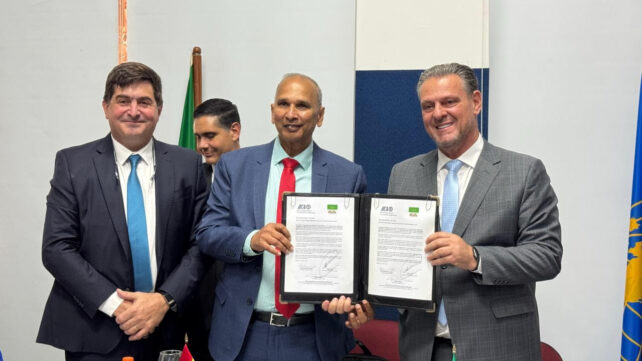
During a recent session of the Southern Agricultural Council (CAS), Muhammad Ibrahim, the Director General of the Inter-American Institute for Cooperation on Agriculture (IICA), provided an update on the development of the 2026-2030 Medium-term Plan (MTP).
This strategic document is designed to serve as a comprehensive framework guiding IICA’s activities throughout Ibrahim’s tenure as the agency’s leader, focusing on agricultural and rural development within the Americas, as per a release from the association. Following Ibrahim’s presentation, the council’s ministers offered suggestions for additional priority areas to be incorporated into the plan.
The MTP functions as a vital instrument for directing IICA’s technical cooperation efforts. Its formulation has been spearheaded by Ibrahim, a distinguished Guyanese agronomist who assumed leadership of the inter-American organization in January. The plan is being crafted through ongoing consultations with various stakeholders, notably including regular dialogues with IICA’s Member States to ensure that the support provided aligns with the diverse needs of countries across the continent.
According to the release, CAS itself is an influential platform for policy dialogue and coordinated action planning among the agricultural ministers of Argentina, Bolivia, Brazil, Chile, Paraguay, and Uruguay.
The recent meeting was convened in Brasília and was overseen by IICA, which provides the secretariat’s technical and administrative support.
IICA said that in Ibrahim’s address, he emphasized the importance of enhancing IICA’s role in harnessing technological advancements, particularly in areas like biotechnology, information technology, and artificial intelligence.
He also outlined key focus areas for the upcoming four years, highlighting “the growing importance of agricultural natural resource management, given the ongoing structural transformation of the sector”, along with the need to address the effects of transboundary pests and diseases on rural economies.
Ibrahim drew attention to the agricultural diversity across the Americas, pointing out that tailored approaches—referred to as “differentiated strategies”—are essential for effective cooperation in regions such as Mesoamerica and the Caribbean. He underscored the opportunities available to nations with more advanced agricultural sectors and reiterated IICA’s role in fostering knowledge exchange throughout the continent.
The meeting was chaired by Carlos Fávaro, Brazil’s Minister of Agriculture and Livestock, with Deputy Minister Cleber Soares present. Also participating were several high-level officials, including Uruguay’s Minister of Livestock, Agriculture, and Fisheries, Alfredo Fratti; Bolivia’s Minister of Productive, Rural, and Water Development, Óscar Mario Justiniano, who temporarily presided over the CAS; Paraguay’s Deputy Minister of Agriculture and Livestock, Marcelo González; José Carlos Martin, President of Paraguay’s National Animal Health and Quality Service (SENACSA); Argentina’s Undersecretary for Agri-food Markets and International Insertion, Agustín Tejeda; and Chile’s outgoing Minister of Agriculture, Ignacia Fernández.
Ibrahim outlined four principal thematic areas for the 2026-2030 MTP: first, international trade, regional integration, agribusiness, and production chains; second, agricultural health, food safety and quality, and biosecurity; third, science, technology, and innovation aimed at productive growth; and fourth, the sustainability of natural resources, emphasizing water, soil, and biodiversity management in light of current global and regional trends.
Reportedly, he noted that the plan would also account for the unique conditions and needs of each of IICA’s five regional divisions: Northern, Caribbean, Central American, Andean, and Southern. An important objective is the integration of the “food systems” concept into IICA’s mandate—an approach that extends beyond traditional agriculture to encompass all facets of food production, distribution, and consumption.
The Director General stressed the necessity of bolstering IICA’s technical capacities and detailed plans to develop an operational strategy aimed at mobilizing expertise across the region.
“We have to acknowledge the growing complexity of agri-food systems, which means considering more issues and more social actors. Today we are witnessing a reconfiguration of agri-food trade in an uncertain international environment. And we also need to take into consideration changes in consumption habits, the demand for food and the emergence of new nutritional and food security challenges”, Ibrahim told the ministers.
The release stated that member countries contributed additional priorities for inclusion in the MTP, emphasizing the importance of a participatory approach in its formulation. Key points raised included the need to prioritize boosting agricultural productivity and efficiency, accelerating innovation and technology adoption, and leveraging biotechnology, artificial intelligence, and other new solutions to support producers.
Furthermore, the ministers underscored the importance of enhancing regional integration into international markets, reiterating the critical role of agriculture in achieving this goal.
Disclaimer: The comments posted do not necessarily reflect the views of DominicaNewsOnline.com and its parent company or any individual staff member. All comments are posted subject to approval by DominicaNewsOnline.com. We never censor based on political or ideological points of view, but we do try to maintain a sensible balance between free speech and responsible moderating.
We will delete comments that:
See our full comment/user policy/agreement.