




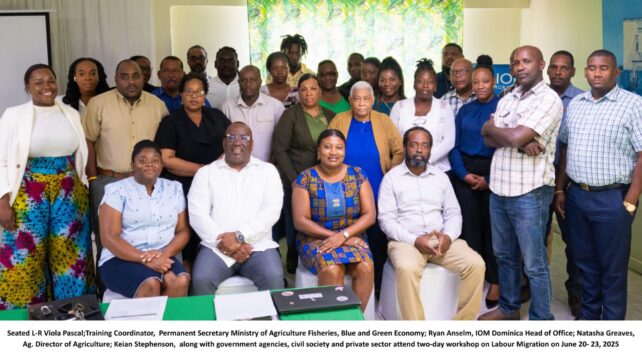
A two-day Labour Migration Training hosted on June 20 and 23 in Roseau brought together key government agencies, civil society actors, private sector and technical experts to strengthen Dominica’s capacity in labour migration governance; an urgent step as the country works to revitalize its agricultural sector.
The training, organized by the International Organization for Migration (IOM) in partnership with the Ministry of Agriculture, Fisheries, Blue and Green Economy, falls under the project “Development of the Agricultural Sector in Dominica by Strengthening Migration Governance.” The sessions aimed to enhance understanding of migration policy frameworks, migrant worker protections, Innovative Approaches to Labour Migration Management and inter-agency collaboration in addressing labour shortages in agriculture.
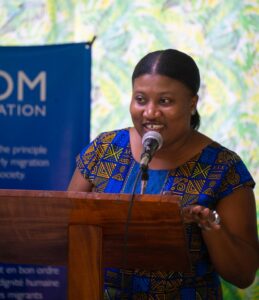
Delivering opening remarks, Natasha Greaves, Head of Office at IOM Dominica, emphasized that thoughtful migration policy is a key enabler of national development.
“We recognize the importance of effective governance and management of labour migration to ensure the well-being of our migrants and the prosperity of our nation,” said Greaves. “Labour migration is an essential component of global economic and social development. It allows for the transfer of skills, cultural exchange, and economic growth”.
As Dominica aims to boost agriculture’s contribution to a projected $700 million to the GDP by 2030, labour shortages remain a significant barrier. The training tackled issues including an agingfarming population, youth disengagement, emigration, and climate-related disruptions such as hurricanes and drought.
Mr. Ryan Anselm, Permanent Secretary of the Ministry of Agriculture, highlighted the sector’s demographic and structural challenges:
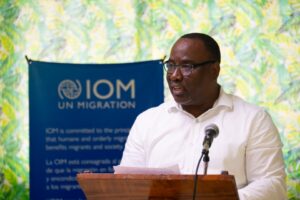
“Dominica, like many small island developing states, faces tremendous challenges in agriculture. Our realities are clear, we grapple with an aging farmer population. I believe our average age is now between 65 and 70. That is alarming,” he stated. “We must encourage youth participation, enhance data collection, and implement a strong migrant labour policy if we are to move forward. Let us also remember that it’s not only labour, climate change, pests, diseases, and market challenges are also pressing concerns.”
One of the key interventions discussed is the National Agricultural Labour Task Force, a multi-sectoral body led by the Ministry of Agriculture. The task force is exploring ways to create controlled, temporary migration channels to meet workforce needs while ensuring fair treatment and integration of foreign workers.
Keian Stephenson, Acting Director of Agriculture, affirmed the importance and timeliness of the initiative:
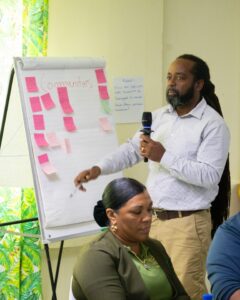 “It’s a timely initiative because within the agricultural sector, we face the dual challenge of labour shortages and migration. Our people are migrating, and at the same time, we need to bring in labour. This training helps us to begin addressing both challenges simultaneously.”
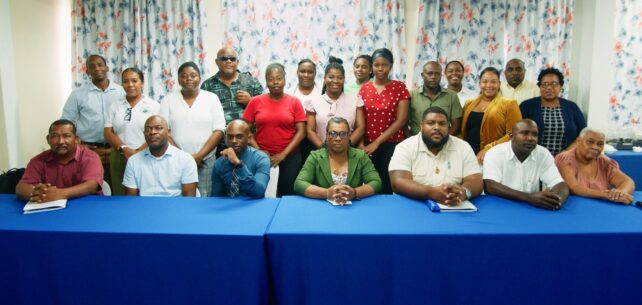
Participants explored tools for data-driven, gender-sensitive policymaking, with a focus on integration and protection for migrant workers. The sessions were attended by representatives from the Ministry of Agriculture, Fisheries, Blue and Green Economy, of Ministry of Labour, Ministry of Environment, National Development Foundation of Dominica, alongside private sector partners including the AID Bank and DAIC, academia, and civil society.
Regional Labour Policy Advisor and workshop facilitator Brittany Braithwaite encouraged participants to think beyond their silos and act collaboratively.
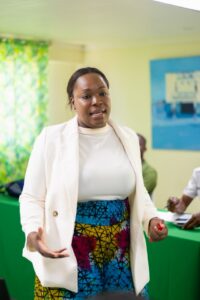
“I anticipate that participants will now take immediate actions aligned with their roles, understanding how they can positively impact migrants who are also contributing to our economies,” she said. “Having agriculture, labour, and the private sector in the same room creates an opportunity for greater cross-sector communication. If sustained, this could have real, positive national impact.”
Greaves called for continued coordination among all stakeholders:
“Let us continue to strengthen our collaboration to address the challenges of labour migration. By doing so, we can harness its full potential to support our agricultural sector, enhance food security, and create more sustainable livelihoods for all.”
The Labour Migration Training is one of several initiatives under Dominica’s broader strategy to modernize agriculture through strategic labour management, climate resilience, and migration governance.
I think this meeting was a very important one but the subject of migration of labor into Dominica while important there is something missing.The number of young men sitting idle along the roads or in some instances in liquor shop or maybe smoking what is mentioned as the new agricultural product for the country should be reminded that parents and grandparents work to leave the country to their care and it is time to lace their boots to make contributions not only to society but to themselves