




 Bananas are crucial to the economies of many Caribbean countries, providing income for smallholder farmers and contributing significantly to export revenues. However, the threat posed by fusarium wilt, particularly the Tropical Race 4 (Foc TR4) strain, is a challenge that the countries need to confront with urgency and collaboration.
While the disease has not yet been reported in the Caribbean, experts advise the countries to adopt a multi-dimensional approach to control and manage this threat through prevention, early detection, and contingency planning.
“Small Island Developing States (SIDS) in the Caribbean are particularly vulnerable to external shocks and climate-related changes including exacerbation and proliferation of plant pathogenic diseases like Foc TR4,” said Jean Baptiste Kemuel, Chief of Extension and Rural Advisory Services at Saint Lucia’s Ministry of Agriculture, Fisheries, Physical Planning, Natural Resources and Co-operatives.
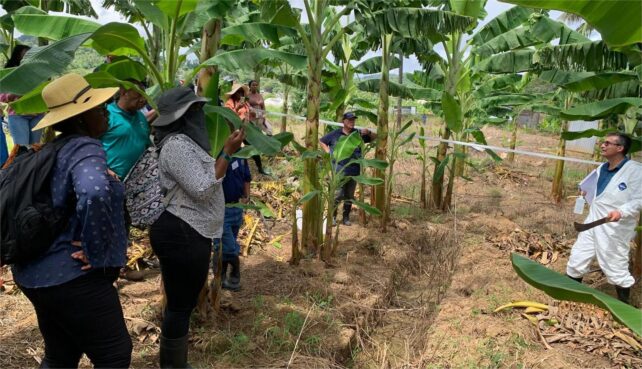
With the support of the Food and Agriculture Organization of the United Nations (FAO) in partnership with the Caribbean Plant Health Directors Forum (CPHD), using the farmer field school (FFS) approach, technical staff, extension workers, and other stakeholders were trained to prepare for a potential Foc TR4 incursion in the Caribbean. Participants came from 10 Caribbean countries: Barbados, Belize, Dominica, Grenada, Guyana, Jamaica, Saint Lucia, Saint Vincent, Suriname, and Trinidad and Tobago.
“Through this training, we are equipping countries to conduct surveillance and monitoring, analyze risks, and enforce strict phytosanitary measures to prevent the introduction of the pathogen and contain it swiftly in case of any incursion,” explained Maged Elkahky, FAO’s plant pathologist in his keynote address. He added that strengthened interregional collaboration is equally crucial for efficiently preventing and managing Foc TR4 in the region.
Unlike other plant diseases that can be managed with pesticides or cultivation practices, TR4 is particularly insidious. Once it invades the soil, it can persist for decades, banning banana production and devastating farmers’ livelihoods.
Why Bananas Matter
Bananas are an economic lifeline for many communities in the Caribbean and Latin America where over 28 percent of the world’s bananas are grown. In 2022, the region’s production volume of bananas and plantains reached over 40 million metric tons.
The latest research, best practices, and innovative solutions were shared during the weeklong training to combat this devastating disease.
“Bananas and plantains are not only important for income generation but also for nutrition security in the Caribbean. TR4 is already present in South America and Caribbean countries must work hard and together to increase preparedness focusing on prevention, biosecurity measures, early diagnostic and contingency. This is the first workshop on TR4 focused on the Farmer Field School approach and the participants are now better prepared and will share knowledge in their respective countries,” stated Melvin Media, FAO’s Plant Production and Protection Officer.
Yes Mr.Rice fig should be $10.00 because there is no competition.All you go and listen to UWP,do nothing and all you abandoned the land.Let somebody sell a han fig for $1.00 and you will see if $5.00 fig do crying.Our problem,we too greedy.
Sometimes I wonder if you go to a rum bar before you write this indecipherable, convoluted gibberish. Keep out the rum shop and at least try to write something edifying for once.
Dominica banana farmers did very well for themselves under previous leaders. They were a proud and economically independent people. Due to lack of foresight and efforts to keep this thriving industry alive, it is now practically dead. The powers that be thought that the CBI scheme was a much better substitute.
Can the banana industry regain its once preeminent economic status? I think so, but surely not under this Hard Head Harry (3H) government.
AA….d last time a farmer told me is $5.00 for a hand of fig…and its going up to $8…becausewater go up…..I think the carbal should consider importing fig from Guatemala
There are over 1,000 different banana species why can’t we diversify and grow those. They are many disease resistant banana species btw instead of the common yellow banana which we all know