




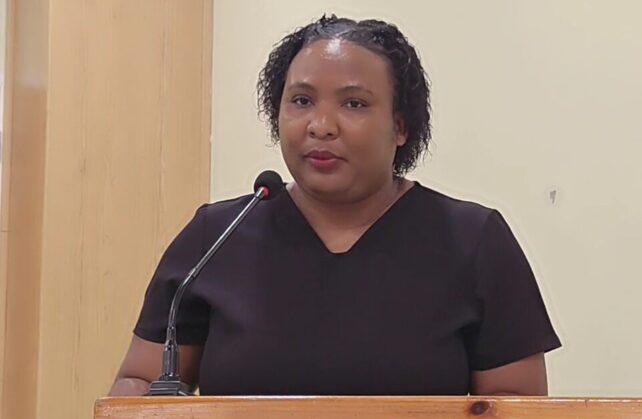
Endocrinologist working with Dominica’s Ministry of Health, Dr. Natasha Maxime – Esprit, has called on citizens to take greater personal responsibility for their health as the island continues its fight against diabetes and other non-communicable diseases (NCDs). The appeal was made during an address at the Dominica Diabetes Association Conference in recognition of World Diabetes Day on Friday, November 14, 2025.
Since joining the Ministry in 2022, the specialist has focused on the prevention, diagnosis, and management of endocrine disorders, with diabetes accounting for 75 percent of patients seen. Each month, according to Dr. Maxime-Esprit, she consults with 200 to 300 patients across Dominica’s health districts, ranging in age from a three-year-old with type 1 diabetes to a 93-year-old with type 2 diabetes.
“Diabetes is no respecter of age nor gender,” the endocrinologist stated, noting that the disease affects individuals across all demographics.
The presentation, titled A Call to Personal Responsibility, highlighted the importance of individuals knowing their health status and making proactive choices. While this year’s theme focused on diabetes in the workplace, the speaker stressed that responsibility begins with each person.
Dr. Maxime-Esprit provided an anecdote to illustrate the point: on November 5, a 35-year-old woman presented to a clinic with blurry vision and severe headache. Tests revealed dangerously high blood pressure and blood sugar levels, leading to a diagnosis of type 2 diabetes and hypertension. The patient, who had not undergone blood tests since age 18, had unknowingly been diabetic for at least three months. Lifestyle factors, including alcohol consumption and poor diet during a music festival, had triggered the crisis.
The endocrinologist reported that in the past five years, Dominica has recorded approximately 531 new cases of type 2 diabetes, with women representing the majority of diagnoses. The youngest patient was just 15 years old.
The Ministry of Health has intensified its campaign against NCDs, expanding free specialized clinics, nutrition services, and screening programs. Health promotion activities are conducted island-wide, from roadside screenings to educational sessions in workplaces and homes.
Despite these efforts, Dr. Maxime-Esprit pointed out that medical interventions alone are insufficient.
“No matter how many clinics we hold, blood tests we indicate, medications we prescribe, the fight against diabetes begins with education and personal responsibility,” the doctor said.
She identified three major contributors to diabetes complications: unhealthy lifestyles, disregard for health when feeling well, and non-compliance with prescribed treatment. These, she noted, are largely dependent on individual choices rather than healthcare providers.
Dr. Maxime-Esprit urged citizens were to take simple steps such as regular health checks, purchasing home monitoring devices, and setting aside funds for preventive care.
“Though I am feeling perfectly fine, I am going to get myself checked just in case something is wrong,” she advised as a guiding principle.
The young woman whose case was shared is now responding well to treatment, having embraced lifestyle changes and medical guidance. According to Dr. Maxime-Esprit, her story was presented as a reminder that early detection and personal responsibility can prevent severe complications such as blindness, heart attack, or kidney failure.
The endocrinologist issued a challenge to the public: “Choose a day throughout the month of November. Sit by yourself or with your family and make a health plan. Visit your nearest health center. Get your general health check done. Know your status and make the necessary changes. Your health is your responsibility.”
Reassuring patients of continued support and quality care from the Ministry of Health, Dr. Maxime-Esprit ended on a hopeful note.
“Diabetes is not a death sentence. It can be managed and complications can be prevented,” she affirmed.
“Reassuring patients of continued support and quality care from the Ministry of Health, Dr. Maxime-Esprit ended on a hopeful note.”
“Diabetes is not a death sentence. It can be managed and complications can be prevented,” she affirmed.
Let us agree she ended with a political statement, She need to shut to F-up! Because she spews false hope rather than treating people medically’ reading her crap angers me; one who was born a diabetic. My entire family on both side of the equation are affected by the diseases, that means its heredity . She keep running her mouth playing politics talking about ministry of health while people are dying! One of my late sisters was hospitalized with high levels of glucose in her system, quacks like her fail to get it under control, my sister Barbara, walked out of the hospital and died that night!
Diabetes is not a death sentence if it is treated effectively. In Dominica its about talk rather than treatment!
I was in Dominica it would have killed me!
In regard to diabetes mellitus, Joseph von Mering and Oskar Minkowski are commonly credited with the formal discovery (1889) of a role for the pancreas in causing the condition. In 1893, Édouard Laguesse suggested that the islet cells of the pancreas, described as “little heaps of cells” by Paul Langerhans in 1869, might play a regulatory role in digestion. These cells were named islets of Langerhans after the original discoverer. In the beginning of the 20th century, physicians hypothesized that the islets secrete a substance (named “insulin”) that metabolises carbohydrates. The first to isolate the extract used, called insulin, was Nicolae Paulescu. In 1916, he succeeded in developing an aqueous pancreatic extract which, when injected into a diabetic dog, proved to have a normalizing effect on blood sugar levels.
If it was as simple as she pretends a cure would long be found! Even in the common era people suffered from diabetes.
“The condition known today as diabetes (usually referring to diabetes mellitus) is thought to have been described in the Ebers Papyrus ( c. 1550 BC). Ayurvedic physicians (5th/6th century BC) first noted the sweet taste of diabetic urine, and called the condition madhumeha (“honey urine”). The term diabetes traces back to Demetrius of Apamea (1st century BC). For a long time, the condition was described and treated in traditional Chinese medicine as “wasting-thirst”). Physicians of the medieval Islamic world, including Avicenna, have also written on diabetes. Early accounts often referred to diabetes as a disease of the kidneys. In 1674, Thomas Willis suggested that diabetes may be a disease of the blood. Johann Peter Frank is credited with distinguishing diabetes mellitus and diabetes insipidus in 1794.”
Note: More to come!
Diabetes occurs when the pancreas doesn’t release the right hormones, or when the body doesn’t respond to those hormones properly. That disrupts our body’s ability to regulate blood sugar, which can lead to serious health issues.
To understand how that works one need to look at how the pancreas functions in a healthy endocrine system.
The endocrine system is made up of glands throughout the body that release hormones. These include:
Pituitary gland – which controls growth
Ovaries and testes – which influence reproduction
The pancreas – which helps manage blood sugar and metabolism!
How Does the Endocrine System Work?
Despite the variety of glands and hormones, they all have one shared goal; keeping the body in balance. The endocrine system works closely with the nervous and immune systems to respond to changes and maintain stability, known as homeostasis. It does this by releasing hormones into our bloodstream, which then travel to different parts of the body.
More To Come:
It doesn’t appear to me whatever is her name knows how the endocrine system, and pancreas works!
Understanding the Pancreas
Assume; one eat a mango; as a matter of fact fruit or anything. As the body digests it, our blood sugar rises. Glucose from what we eat is a quick source of energy, However, too much of it can be harmful. That’s where the pancreas steps in. It senses the rise in glucose and releases insulin, a hormone that helps your cells either use or store that sugar. As glucose levels return to normal, the pancreas slows its insulin production.
“This back-and-forth” helps keep the body fueled and balanced. Nevertheless in someone with diabetes, this process doesn’t work properly. Now to any idiot who wish to give me thumbs down go right ahead listen to that woman’s fart, and die without medical intervention:
The most effective treatment, is to go on a regimen of insulin!
“Diabetes is no respecter of age nor gender, the endocrinolo stated, noting that the disease affects individuals across all demographics.” (Natasha Maxime). That ‘s one hundred (100%) percent, plus correct. Nevertheless; this notion: “Most parents of juvenile diabetics know it takes a “village” to raise a diabetic child. Ignorance, secrecy and false pride are counterproductive to the child’s well being and must be dispelled with. As for the child, parents, family members, teachers, coaches and other potential first responders, low and high blood sugar recognition and emergency triage response are critical.” I can tell you Natasha, all of your words appear to be scripted unfounded rhetoric which has nothing to do with medical science, that pertains to diabetes; the treatment of the disease, for which a cure has yet to be found! “It takes a village” which is an African Proverb: meaning “It takes a village to raise a child; So, Are you contending everybody at home knows medicine!
no offense to the doc but she’s not setting a great example
@hmm, please give at least one example of your accusation / statement.
As a Dad of two children who were diagnosed with Type 1 Juvenile Diabetes, I can attest to everything the good doctor stated.
Most parents of juvenile diabetics know it takes a “village” to raise a diabetic child. Ignorance, secrecy and false pride are counterproductive to the child’s well being and must be dispelled with.
As for the child, parents, family members, teachers, coaches and other potential first responders, low and high blood sugar recognition and emergency triage response are critical.
Carbs to insulin ratio, food intake carbs composition and correction factor awareness are also critical concepts. Ketone levels in the urine is also a definite must know.
I can attest that with the hard and diligent attention to healthcare details, a Type 1 diabetic can aspire and achieve every vocation except being a pilot.
The fast evolving medical technology field now allows Type 1 diabetics the option of wearing subcutaneous glucose monitors with automated insulin…
Mr. Lizard, I read many of you comments over the years; and though I desire not to be offensive, I must inform you where she said it takes a village is nonsense you know! This proverb is so widely used in Africa that there are equivalent statements in most African languages, including “One knee does not bring up a child” in Sukuma and “One hand does not nurse a child” in Swahili. The widespread use of this proverb by cultures around the world shows its timelessness and relevancy. The saying is used in America to evoke feelings of community on the small scale as well as on the national and even global scale.The proverb may have its origins in the Bible, since it reflects a worldview regarding unity and self-sacrifice expressed in several passages of the Bible, such as Ecclesiastes 4:9,12 and Isaiah 49:15-16. This worldview is commonly seen in African cultures today. In many African communities it is common for a child to be raised by its extended family, not related to diabetes