




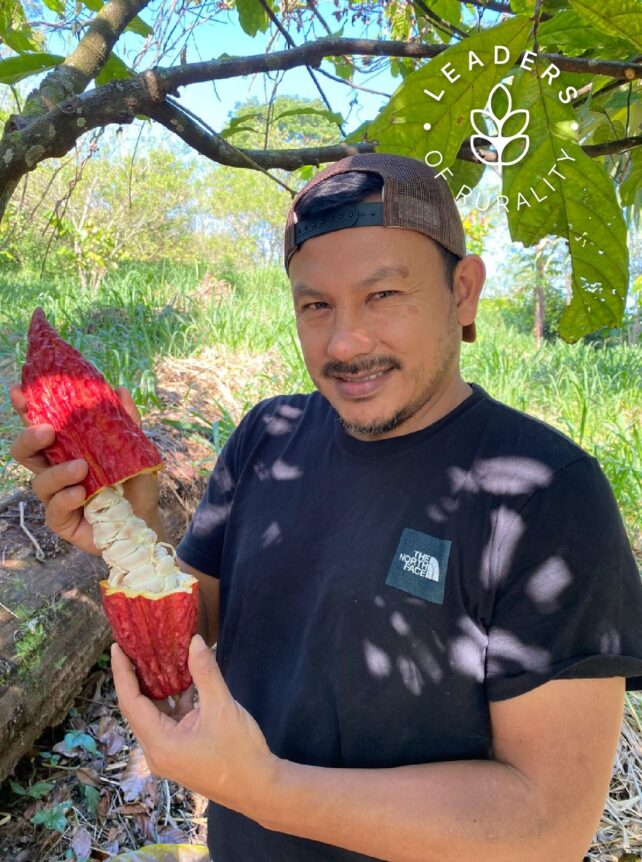
Erick Geovany Ac Tot, a well-known Guatemalan entrepreneur specializing in cocoa, has been honored with the title of Leader of Rurality in the Americas by the Inter-American Institute for Cooperation on Agriculture (IICA).
An IICA report states that Ac Tot has dedicated years to supporting small farmer groups, promoting premium cocoa cultivation, and conserving heirloom cocoa trees, in addition to being a cocoa tasting expert.
As part of this recognition, he will be awarded the “Soul of ‘Rurality’” prize, an accolade within an IICA initiative that highlights individuals making significant contributions in rural areas across the hemisphere. The program aims to spotlight those shaping regional and global sustainability, as well as advancing food security and nutritional stability.
Ac Tot explains that, “My two unusually short last names reflect my indigenous Q’eqchi Mayan roots and the Alta Verapaz region of northern Guatemala where I was born and raised.” This statement underscores his deep connection to the land and the ancestral legacy of cultivating and consuming cocoa long before the arrival of colonization.
Much like an explorer, Erick seeks out and preserves Creole cocoa trees that grow clandestinely within Guatemala’s dense forests. These trees, which “grew without anyone planting them,” closely resemble the ancestral cocoa cultivated by the Maya. His efforts are driven not solely by adventure but also by the importance of safeguarding these plants, which carry the DNA of some of the world’s finest cocoa varieties. Preserving them directly enhances Guatemala’s cocoa quality, making it more competitive in high-end chocolate markets.
According to IICA, his journey began in a village established in the 1950s by families migrating from other regions, including his grandparents’ family. They arrived in northern Alta Verapaz through a government-led agricultural development program. Initially, only three families settled there, leasing land to grow corn, raise pigs, and cultivate beans, according to Erick.
Gradually, the village expanded as more families arrived, leading to the formation of a cooperative through which land was purchased and small farms established. Each family cultivated various crops, including cocoa, which became a cornerstone of their livelihood. Erick, the eldest of seven children and the only one born in the village, later moved with his family to Cobán, the department’s main city, where his father secured employment. There, Erick pursued his education and earned a degree in Agronomy from Universidad de San Carlos de Guatemala.

Reflecting on his childhood, Ac Tot recalls visiting his grandparents’ village during vacations, describing it as a “paradise with forests and wild animals, where my family had learned to cultivate the land.” Interestingly, during his university years, he pursued professional football to fund his studies, even playing for Cobán Imperial, yet ultimately decided to follow a different career path after graduating.
His first roles involved working with European cooperation programs focused on community development and agriculture. Later, he worked at the university and then returned to his community to participate in a conservation-focused cooperation project, engaging with local farmers near the Lachúa national park.
Spending twelve years with the International Union for Conservation of Nature (IUCN), Ac Tot became immersed in the cocoa value chain, reconnecting with the traditional methods of growing cocoa in his grandparents’ village—methods that used to be common in home gardens. This experience laid the foundation for his current entrepreneurial pursuits.
Today, he leads Guatemala Finest Kakau and Guatemala Cacao Company, while also managing the family farm named after his mother, Ana María. The farm emphasizes exporting high-quality cocoa and genetic selection, with over twenty-five years dedicated to selecting trees based on productivity, disease resistance, pollination compatibility, and flavor profile.
Ac Tot actively collaborates with small farmer organizations and cooperatives in northern Guatemala, where more than half of the country’s cocoa production occurs. He works with government and non-governmental agencies to secure funds aimed at enhancing production, improving plantation management, and advancing post-harvest processes, including turning cocoa into chocolate and other products.
In addition to his entrepreneurial activities, Erick pursues his passion as a cocoa taster. He explains that “some samples are not very good,” demonstrating the tasting process with a small container of cocoa paste. The tasting follows standards developed by the international organization Cacao of Excellence, emphasizing factors like bean size, moisture content, roasting quality, and flavor notes, including bitterness, astringency, fruit, and floral aromas.
He stresses the importance of training to develop a refined palate, noting that “you have to be trained to do this.” During training, tasters sample a wide range of chocolates—from exceptional to poor—to calibrate their senses. Scores are assigned from 1 to 10, with anything below 6.9 considered defective and unsuitable for high-quality products. Scores between 8 and 9 indicate cocoa with complex, lingering flavors, while a perfect 10 remains exceedingly rare, as Erick has yet to encounter one.
While market preferences influence what types of cocoa are sought after, Erick emphasizes that flavor profiles—such as floral, fruity, or acidic notes—vary according to consumer demand in regions like Europe, Asia, or the United States.
His dedication to uncovering the origins of heirloom cocoa trees in Guatemala stems from his early experiences. His uncle once told him about small plots with two wild cocoa trees, which had not been planted but grew naturally, and which he later found in the forests of Guatemala. These trees, with white seeds unlike any other, represented a living link to Mayan heritage. After a challenging trek through dense jungle, Erick and his team discovered the trees, a discovery that filled him with emotion—recognizing that these ancient trees, increasingly threatened by land conversion, still exist in at least fifteen scattered locations across Guatemala, including Petén, Izabal, and Alta Verapaz.

They meticulously record and document these heirloom plants, planting their pods in a dedicated clonal garden to preserve this genetic treasure.
Looking to the future, Ac Tot reflects on the journey of cocoa from pre-Columbian times to the present globalized market. He shares ongoing projects, including developing a chocolate factory in Cobán with his daughter and expanding the Ana María farm. His family members, including professionals, are actively involved in these ventures.
He affirms that “Cocoa is part of our culture, part of our traditions,” recalling that in Maya and Olmec times, it was not only consumed as food and used in rituals but also served as currency. It is a logical progression that cocoa continues to be a vital element for Guatemala’s economic development.
Disclaimer: The comments posted do not necessarily reflect the views of DominicaNewsOnline.com and its parent company or any individual staff member. All comments are posted subject to approval by DominicaNewsOnline.com. We never censor based on political or ideological points of view, but we do try to maintain a sensible balance between free speech and responsible moderating.
We will delete comments that:
See our full comment/user policy/agreement.