




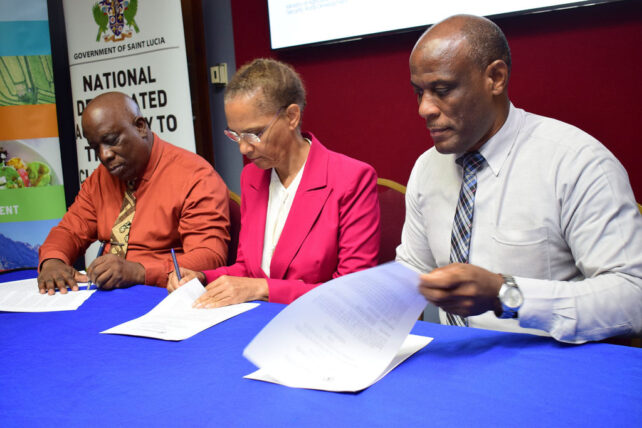
The Food and Agriculture Organization (FAO), in collaboration with St Lucia’s government ministries, officially launched the FISH-ADAPT Project on July 3, 2025.
This ambitious initiative, valued at USD 16.7 million, according to an FAO press release, is primarily financed through the Green Climate Fund (GCF), which contributed USD 14.75 million. Additional support comes from the Ministry of Agriculture with USD 307,250 and the Ministry of Finance with USD 1.66 million, marking it as the largest investment in St Lucia’s fisheries sector to date. The project aims to bolster the resilience and productivity of the nation’s fisheries amidst the challenges posed by climate change.
The FAO projects that over a span of five years, FISH-ADAPT will impact around 75,000 individuals, including 13,000 directly involved and 62,000 indirectly benefiting, which accounts for roughly 41% of the island’s population. The report also listed beneficiaries as encompassing marine fishers, sea-moss farmers, fish vendors, processors, and inland aquaculture farmers, along with their families.
The initiative seeks to modernize Saint Lucia’s fisheries sector by improving safety standards, increasing yields, and fostering a circular economy that minimizes waste and promotes sustainable resource use. Strengthening fish value chains and making coastal and aquaculture systems more resilient to climate impacts are central goals, with an emphasis on diversifying income streams for local communities.
FISH-ADAPT incorporates a range of climate-smart strategies aimed at enhancing sustainability and operational efficiency. Key activities include providing fishers and aquaculture farmers with improved access to weather data, upgrading landing sites, and promoting sustainable offshore fishing practices. The project will prioritize high-activity and climate-vulnerable zones across the island, including inland aquaculture operations.
Infrastructure improvements such as rehabilitating fish landing sites with eco-friendly solutions—like mangrove restoration and reef reinforcement—are planned, along with climate-proofing critical facilities like jetties and processing plants, especially in areas such as Gros Islet, Castries, and Soufrière.
Addressing the environmental and ecological challenges, FAO states that FISH-ADAPT aims to protect vital ecosystems, including coastal mangroves and coral reefs, which are under threat from pollution, siltation, and runoff. The project will introduce demonstration farms, energy-efficient technologies, and storm-resilient infrastructure to support aquaculture and sea-moss farming.
Additionally, the initiative aligns with Saint Lucia’s national fisheries and climate resilience strategies, reinforcing its role as a foundational element of the country’s blue economy.
ST. Lucia’s Minister of Agriculture, Fisheries, Food Security and Rural Development, Alfred Prospere noted during the signing ceremony for the project, “The true impact of FISH-ADAPT will not be measured in dollars, but in lives improved, coastlines protected, livelihoods strengthened, and futures made more secure.”
“We are proud to support Saint Lucia and the wider Caribbean in advancing integrated solutions that safeguard both people and planet, while directly addressing the unique vulnerabilities of Small Island Developing States (SIDS),” added Dr. Renata Clarke, Subregional Coordinator for FAO Caribbean.
Disclaimer: The comments posted do not necessarily reflect the views of DominicaNewsOnline.com and its parent company or any individual staff member. All comments are posted subject to approval by DominicaNewsOnline.com. We never censor based on political or ideological points of view, but we do try to maintain a sensible balance between free speech and responsible moderating.
We will delete comments that:
See our full comment/user policy/agreement.