




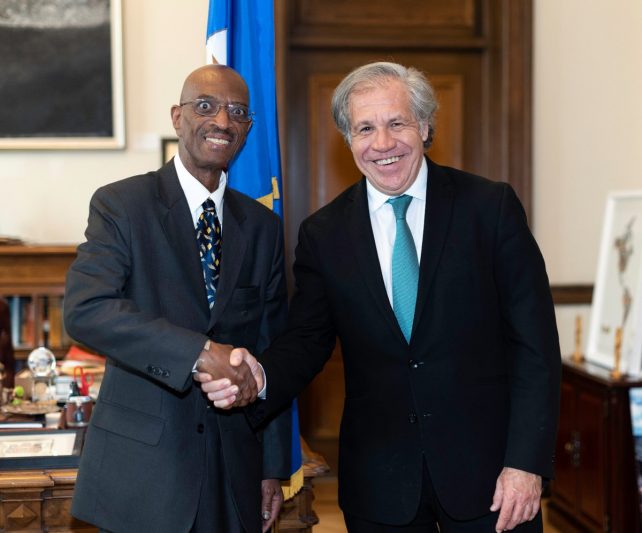
Former Dominican ambassador to the United Nations, Crispin Gregoire, has urged CARICOM leaders to break their silence and respond decisively to the unfolding crisis in Venezuela following the dramatic capture of President Nicolás Maduro. Gregoire expressed disappointment at what he described as a “timid” regional response, stressing that this is the moment Caribbean leaders must stand together and engage directly with Washington.
According to Gregoire, the United States executed a precision operation that stunned Venezuela’s military and political establishment. He revealed that U.S. intelligence had penetrated Maduro’s inner circle, even buying off members of his personal security detail. Families of those bodyguards were reportedly relocated to the United States under new identities before the strike. With their cooperation, a Delta Force team swiftly entered, seized Maduro and his wife, and departed within twelve minutes—leaving Venezuela’s defense minister and armed forces “totally dumbfounded.”
Gregoire, in an interview on Q95 today, warned that the operation raises profound legal and political questions. On the international level, he argued, the U.S. violated Venezuela’s sovereignty, ignoring norms of international law. Domestically, he noted that President Trump bypassed Congress, sparking opposition among lawmakers who question the administration’s authority to intervene. “The U.S. invokes international rules when convenient,” Gregoire said, “but ignores them when it suits their interests.”
Maduro now faces a sweeping indictment in U.S. courts, reportedly spanning 700 pages and portraying him as a drug kingpin responsible for facilitating massive cocaine shipments. Gregoire drew parallels to the case of Panama’s Manuel Noriega, who was tried in the United States after being forcibly removed from power. He questioned whether U.S. courts have legitimacy in prosecuting a foreign leader taken under such circumstances, calling the act “kidnapping.”
The ambassador also highlighted the destabilizing implications for Venezuela. Armed groups, including Colombian factions and Maduro’s own colectivos militia, remain active and heavily armed. With the government in disarray, Gregoire warned that Venezuela’s stability is “in crisis, starting yesterday.”
Complicating matters further, he noted reports that Caribbean politicians may be implicated in Maduro’s alleged drug network. Recent seizures of cocaine in Dominica and investigations into regional energy officials have fueled speculation of Caribbean involvement. Gregoire expressed concern that such revelations could tarnish the region’s credibility and deepen its vulnerability.
Despite these mounting challenges, Gregoire’s central message was clear: CARICOM cannot remain passive. He criticized regional leaders for failing to publicly reach out to President Trump or articulate a collective position. “The Caribbean leaders have been whipped into submission,” he said, “and for their own survival, they now have to play Donald Trump’s tune.”
For Gregoire, the crisis is not only about Venezuela’s future but also about the Caribbean’s ability to assert itself in the face of great power intervention. His call is a reminder that silence, in moments of geopolitical upheaval, carries its own risks.
If a strong case would be brought to Trump about Skerrit rule including links to Venezuela and China, cocaine and rule of law would de rest of CARICOM sit like lame ducks?
Former Ambassador Crispin Gregoire is on point here with his call for CARICOM collective action in face of the removal of Nicolas Maduro and his wife from office.
When Maduro was threatening to invade 2/3 of Guyana and leave them with nothing, CARICOM said nothing.
After CARICOM gave HAITI full CARICOM membership, ALL CARICOM STATES still impose visa restrictions on all our hard working black Haitians brothers and sisters. Meanwhile Santo Domingan Prostitutes from Republica Dominicana (a racist country that do not like Haitians and black people) can travel through out CARICOM without visa.
And as for leaders and officials from CARICOM member states who took bribes from Maduro, if they are reprimanded for knowingly taking bribes from Maduro then they would have been wrong to do so.
Meanwhile I am sure my Prime Minister is safe as he never been accused of wrong doing except by those who want him out of public office. They know themselves…
Speaking for speaking sake is usually not very productive in my experience. As distasteful as this action was, where was their voice when the excuses/reasons for the action were supposedly perpetrated? If they did speak up then, their voice would be more authoritative now, because they would be speaking from a place of integrity. If the accusations are true and they said nothing, they better off keeping quiet because whatever they say would be regarded as evidence of cravenness, i.e. benefiting from the largess of a tainted regime, without regard to it’s victims.
@Dreadidiah, have you listened to the statements by the Trump officials after the kidnapping of Maduro? They spoke the truth out loud, the operation was all about getting control of Venezuelan oil and minerals. The US ambassador to the UN made it quite clear before the UN security that America will not allow Russia and China control the oil and minerals of venezuela. Trump has threatened to occupy Greenland to get control of its minerals. Canada, Mexico Cuba and Colombia have all been threatened by the Trump administration to comply with what the US wants or face military occupation. This is not about drugs, if it were the Colombian president would have been kidnapped as most of the cocaine entering the US comes Colombia the difference is Colombia is not sitting on 300 billion barrels of crude oil as Venezuela is.
Yeah CARICOM is conspicuously silent.
It is my view, I may be wrong, that there is more sensitive information surrounding de Venezuela issue that implicates CARICOM.
Skerrit spoke without saying anything really.
Let us consider our student visa situation. Is it a form of backlash? And the timing.
De government flaunts a largesse of funds but they don’t reach certain failing areas of governance. It is visible during election season.
Is our government really producing all of that funds?