



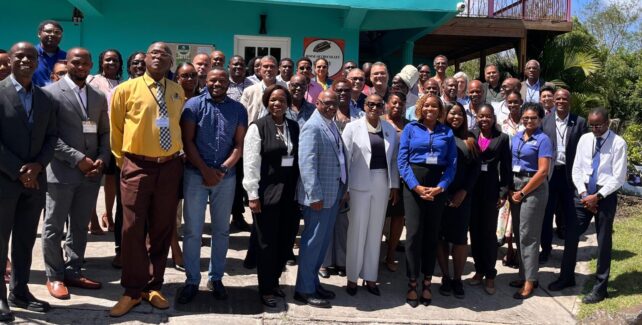
In a recent regional workshop, high-level officials from six Caribbean Small Island Developing States (SIDS)—Antigua and Barbuda, Barbados, Grenada, Guyana, Saint Vincent and the Grenadines—reaffirmed their dedication to enhancing water security and advancing the implementation of Integrated Water Resources Management (IWRM).
IRWM is holistic in its approach to management of water resources, promoting the “coordinated development and management of water, land and related resources in order to maximise economic and social welfare in an equitable manner without compromising the sustainability of vital ecosystems and the environment,” as explained by workshop co-facilitator, Global Water Partnership.
The workshop, titled “Leveraging SDG 6 for Accelerated Water Investments in Caribbean SIDS,” took place from July 9 to 10, 2025, in Grenada. The other organizers are the United Nations Environment Programme (UNEP), the G-CREWS Project, and the Government of Grenada.
A joint media statement shared that the event was attended by numerous high-ranking delegates, including permanent secretaries, technical officers, and directors responsible for water and water resource management within their respective governments. Representatives from sectors such as water, agriculture, environment, tourism, and health also participated, underscoring the multi-sectoral nature of water management challenges and solutions.

Vincent Sweeney, Head of the Caribbean Sub-Regional Office of UNEP, described it as “a space for practical peer exchange, collaborative action planning and building forward momentum,” emphasizing the importance of collective progress.
Along those lines, the workshop aimed to foster collaboration among key water stakeholders, facilitate the sharing of best practices, identify investment opportunities, and bolster regional efforts toward achieving Sustainable Development Goal (SDG) 6, particularly Target 6.5.1, which advocates for the full implementation of IWRM by 2030.
Addressing the gathering, Grenada’s Minister for Climate Resilience, The Environment, and Renewable Energy, Hon. Kerryne James, emphasized the importance of water management beyond infrastructure and policy, stating, “It is not just about infrastructure or policy—it is a matter of human dignity, economic security, and intergenerational justice.”

Despite the Caribbean reportedly being one of the most water-stressed regions globally, with limited capacity to store and distribute clean, reliable water, IWRM remains a pivotal regional priority, stressed the release.
“Water security is not just a development issue—it’s the foundation of our region’s resilience, health, economy, and environment. Caribbean SIDS face rising climate threats, aging infrastructure, and chronic underinvestment. The time to act is now,” noted Professor Paulette Bynoe, Chair of GWP-C, highlighting this urgency.
Workshop organizers say that the IWRM is recognized as a participatory, sustainable approach to water resource management that considers social, economic, and environmental factors. They add that while many nations have adopted the concept, the full implementation remains an ongoing effort.
During discussions on strengthening regional implementation efforts, facilitator Chris Corbin highlighted the need to transition from traditional planning to more tangible, inclusive, and phased actions. He emphasized, “We want to move from a planning process to one that is inclusive, and action based. These actions must be realistic—things we can achieve in the short term without requiring major financial investments, while also identifying medium- and long-term actions where external resources are expected to play a role.”

The workshop concluded with a renewed commitment from Caribbean SIDS to enhance cooperation, invest in climate-resilient water infrastructure, and support IWRM implementation through the development of mini action plans tailored for each participating country.
Dr. Roxanne Graham-Victor, Regional Coordinator for GWP-C, described the workshop as a productive environment for meaningful exchange among countries and sectors. She stated that the event provided “a space to bring your country’s story, your sector’s voice, your institutional perspective, and real-world experiences—sharing practical solutions that work or are ready to be tested,” with respect to IWRM.
Disclaimer: The comments posted do not necessarily reflect the views of DominicaNewsOnline.com and its parent company or any individual staff member. All comments are posted subject to approval by DominicaNewsOnline.com. We never censor based on political or ideological points of view, but we do try to maintain a sensible balance between free speech and responsible moderating.
We will delete comments that:
See our full comment/user policy/agreement.