




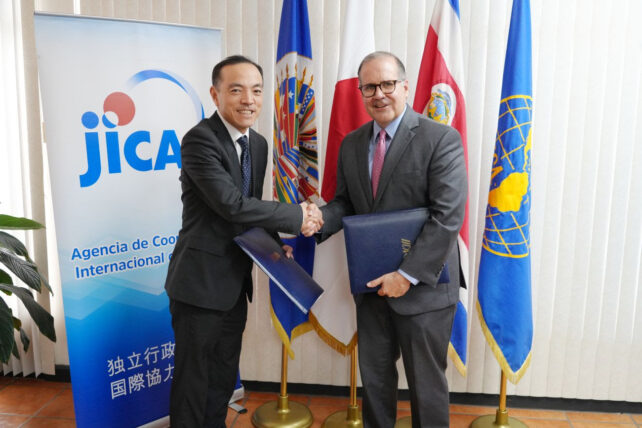
The Inter-American Institute for Cooperation on Agriculture (IICA) and the Japan International Cooperation Agency (JICA) are collaborating to advance the Smallholder Horticulture Empowerment and Promotion (SHEP) strategy across Latin America and the Caribbean. Their goal is to boost income levels among small farmers, enhance food security, and alleviate poverty throughout the region, stated an IICA pres release.
Originally devised in Kenya through Japanese technical aid, SHEP is an agricultural extension model that aims to empower smallholders to become self-reliant managers and adopt a market-driven approach to farming.
This methodology, now adopted in over 60 countries, encourages family farmers to transition from a “produce and then sell” mindset to a “produce to sell” approach. This shift is supported by training in market research, crop planning, and making decisions based on demand.
Implementation of SHEP has led to average income increases exceeding 70% for family horticulture producers within a two-year span, primarily due to enhanced market focus, better planning, and increased business skills.
Keisuke Ito, Director General of JICA’s Latin America and the Caribbean Department, remarked, “Any cooperation agreement truly shines only when it is implemented as agreed, and I trust that this marks the beginning of a very fruitful relationship that will translate into concrete actions to improve the lives of small-scale farmers.”
Lloyd Day, Deputy Director General of IICA, added,“The SHEP approach offers significant opportunities for family farmers to become true managers of their production systems. With support and joint efforts, we can take on the ambitious commitment of improving the living conditions of many farmers and innovating in strategies to strengthen technical assistance and rural extension services.”
A five-year partnership agreement between IICA and JICA was signed, with initial activities beginning in March 2026 in Bolivia.
This involves the project titled “Operationalizing climate-resilient agriculture as a business: a strategic ‘Last Mile’ partnership for the Adaptation Fund,” which incorporates SHEP.
The Bolivian project will span two years and is supported by a strategic alliance of government, academic, and international cooperation institutions, with IICA acting as the implementing agency. Its aim is to empower small-scale producers as entrepreneurs capable of managing climate shocks, ultimately institutionalizing the model to improve financial security and adaptive capacity among rural communities.
Furthermore, IICA and JICA are exploring possibilities to extend the SHEP approach to Paraguay, Central America, and the Caribbean.
Efforts to transform family farming
As part of their joint efforts, IICA and JICA hosted a seminar in San José, gathering more than 250 representatives from international organizations, cooperation agencies, specialists, and key stakeholders from over 20 Latin American and Caribbean countries. The focus was on strengthening support strategies for market-oriented family farming and improving institutional coordination.
Jiro Aikawa, Senior Advisor at JICA, explained that SHEP revolutionizes agricultural extension by bridging information gaps between producers and buyers.
“The SHEP motto is clear: agriculture is a business. When producers study the market before planting and understand who will buy their product and at what quality, they can significantly improve their income”, he stated.
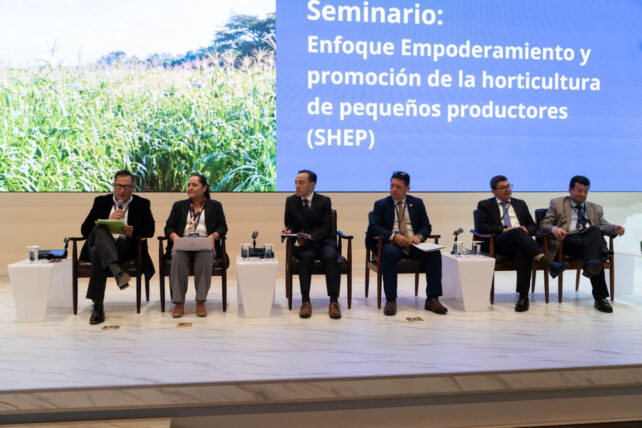
Discussions during the seminar highlighted the main challenges facing family farmers in the region, where they represent 80% of agricultural holdings, employ 60 million people, and produce half of the local food supply. They are vital to regional food security.
Mario León, IICA’s Manager of Territorial Development and Family Farming, noted that small farmers face structural issues such as low productivity, climate vulnerability, limited market access, connectivity gaps, and land tenure problems.
“Overcoming these barriers requires differentiated policies, stronger organizational capacity and increased investment in innovation and digitalization to unlock the economic and social potential of millions of small-scale producers”, he said.
“To unlock their economic and social potential, overcoming these barriers requires tailored policies, stronger organizational capacity, and increased investments in innovation and digital tools,” he said.
Reportedly, the seminar concluded with panels analyzing strategies to help smallholders increase incomes, combat poverty, improve resilience to climate change, and access markets more competitively.
Luis Pocasangre, Director General of the Tropical Agricultural Research and Higher Education Center (CATIE), emphasized the importance of prioritizing markets in production decisions.
“We should not speak of subsistence agriculture, but of producers with business potential. If we do not know how much it costs to produce or which variety consumers want, we cannot turn agriculture into a true business”, he stated.
Yumara Soria, Regional Coordinator of the Central American Agricultural Council (CAC), underscored the need to redefine small farmers as entrepreneurs and strengthen rural extension services.
“We must stop viewing small farmers only as subsistence producers and treat them as agricultural entrepreneurs, providing them with information, financing, and, above all, real access to markets; producing without knowing for what or for whom does not transform their reality”, she said.
Nelson Larrea from CAF – Development Bank of Latin America and the Caribbean’s Technical Analysis and Evaluation Directorate, highlighted the link between profitability and sustainability.
“There can be no sustainability if the producer is not prosperous; it must first be a profitable activity that motivates families to remain in rural areas, and only then can we speak of environmental sustainability and resilience. Financing requires a strong technical component in the territory; methodologies such as SHEP ensure that resources are effectively translated into sustainable business models with impact.”
Disclaimer: The comments posted do not necessarily reflect the views of DominicaNewsOnline.com and its parent company or any individual staff member. All comments are posted subject to approval by DominicaNewsOnline.com. We never censor based on political or ideological points of view, but we do try to maintain a sensible balance between free speech and responsible moderating.
We will delete comments that:
See our full comment/user policy/agreement.