




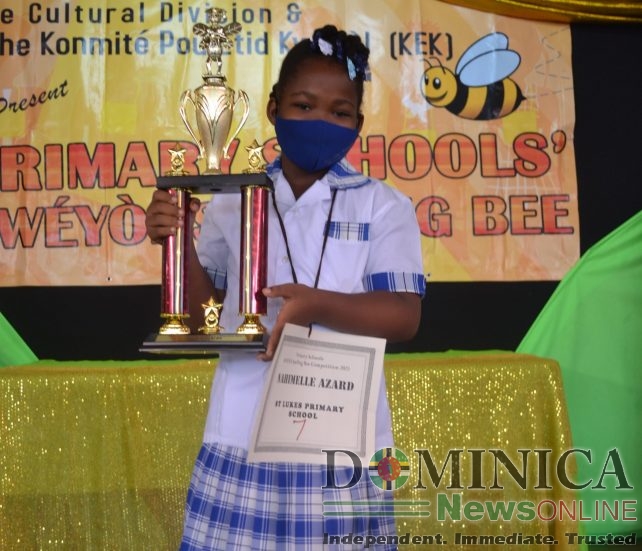
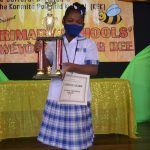
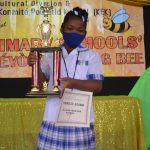
Winner of the 11th annual Kweyol Spelling Bee Competition, Nahimelle Azard is hoping to teach her peers the language, in an attempt to preserve the culture.
The elated St. Luke Primary School student who topped the competition last week, told Dominica News Online (DNO) that while there are challenges to learning the language, the benefits derived from such are numerous.
“Although it was very hard learning to spell and remember each of the words, when you do learn them and are able to use them, it feels very great, because that means you can now have a conversation with someone else in creole,” she stated. “So I would love to be able to teach all my friends and other children so that they too can speak it.”
Her father, Haitian national Nathaniel Azard said he has confidence in his daughter’s ability to achieve this goal, as everything she puts her mind to, she usually achieves.
Teacher at the St Luke Primary, Laurel Peltier, has also showered praises on the young student.
Speaking to our team, she joyfully stated, “I am very excited because we have been in the competition from inception and finally after all these years we have emerged victorious.”
As it pertains to the preparation for the competition, Peltier highlighted the rigorous training of the alphabet, the sounds and spelling that went into their daily session.
She says that at the school, the Kweyol language is included in the timetable as their goal is to acquaint the student with the language at an early age.
This sentiment for more students to learn the language has also been echoed by second and third place runners up Jaheim Sango and Kheanellia Barrie, who initially tied with the winner after the 16 round competition but missed the shot during the tie-breaker rounds.
According to Sango who represented the Baroness Patricia Scotland Primary School, “I would encourage the primary school students and my friends to learn the creole. Although it can be difficult, once you start to practice and start learning to spell the words, you will really like it.”
Barrie, a student at the Atkinson Primary, noted that such competitions provide a foundation for students like her, to incorporate the word learnt in their daily vocabulary.
Only seven schools participated in this year’s competition organized by the Komite Pou Etid Kweyol (KEK) and National Cultural Council and the Division of Culture in collaboration with the Ministry of Education.
Commenting on the low participation, Mr. Christopher, a teacher at the Baroness Patricia Scotland Primary, called on his colleagues to participate when such activities are held and “to show more interest in that aspect of our culture,” before it is completely lost.
The other schools and representatives included: Castle Bruce Primary-Jerlissa Panthier, Ebenezer Seventh Day Adventist Primary- Khaleed Colaire, Newton Primary -Nimer Myer, Penville Primary – Jerillia Marcel, Roosevelt Douglas Primary- Stecie St Louis and Woodfordhill Primary- Destiny Williams.
Meanwhile, Chief Cultural Officer Raymond Lawrence pointed out that KEK, with the assistance of the cultural division, has been very instrumental in researching and publishing several creole publications and assisting with a pilot project to teach creole in schools.
“We are hoping that together with the ministry of education, we can build on further inclusion of the language in our schools, our national curriculum and give greater exposure and promotion to this beautiful language of ours,” Lawrence stated.
He urged both government and the private sector to continue to invest in the preservation and development of our creole language and to also continue to recognize the importance of our kweyol language in our cultural expression in Dominica which he says will build a greater sense of national identity and pride.
“I encourage all Dominicans, especially the young people, to speak the creole whenever the opportunity arises. In that way, we will be helping to preserve our traditions and helping to keep alive a very vital part of our culture,” the Chief Cultural Officer opined.
Acknowledging the huge responsibility and role which the ministry of education plays in changing the perspective of the value of the creole language at schools, Permanent Secretary in the Ministry of Education Chandler Hyacinth pledged their support for the growth of the language at all learning facilities on island.
“I want to encourage our schools and our educational leaders to catch that vision and support the various initiatives as we seek to expose our students to the creole language,” she said.






if there isnt a creole dictionary who know how the words are truly spelled? Ca or ka? kweole or creole or kreole? qui or ki? Maybe they gave them a list of words to spell ahead of time, but still, are they spelled correctly or just according to the person who wrote them down? Remember, creole (french creole) is a broken language. It is pronounced and sometimes spoken differently in different places.
ADMIN: There are several Kwéyòl dictionaries out now. KEK (the organizers) have published their own dictionary.
https://divisionofculture.gov.dm/cultural-institutions-and-groups/11-kommite-pou-etid-kweyol-kek-and-the-folk-research-centre
So right. I tried to study the language and learned that words and grammar vary, even from village to village, in Dominica.
Meanwhile, if a Dominican kid tries to use English and speak English properly (which will be a huge benefit to his or her economic future) other kids taunt the kid for “talking white” – a clear example of racism, by the way.
Is there much variance from dictionary to dictionary on how he words are spelled and pronounced?
There’s also a free app for Android (not sure about iOS) called “St. Lucian Creole Dictionary” that turns your phone into a dictionary. (I realise their Creole is not exactly the same, but it’s pretty close, ee.)
Exactly Steve. Creole differs from place to place. Im sure the Lucian one is different form the Dominican one.