




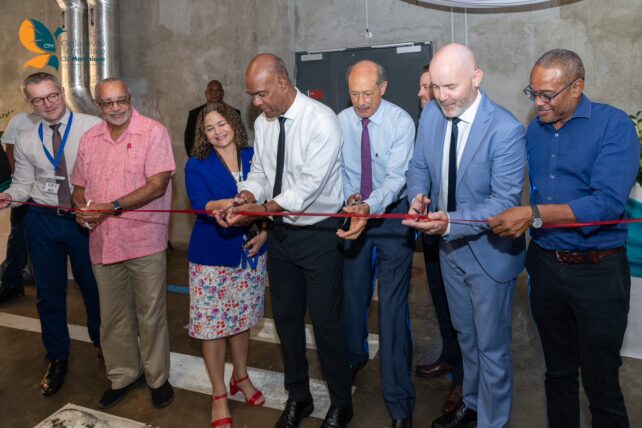
The Caribbean Institute for Nuclear Imaging (ICIN) celebrated its grand opening in Martinique this past weekend, a collaborative effort involving the Territorial Collectivity of Martinique (CTM), the Prefecture of Martinique, the Regional Health Agency (ARS), and the University Hospital of Martinique (CHU).
This groundbreaking medical facility enhances the region’s healthcare offerings by providing specialized cancer screening and diagnostic services to both local residents and international patients. The establishment of this state-of-the-art center represents a significant advancement in the treatment capabilities for cancer, cardiology, and neurology within Martinique and the broader Caribbean region.
Notable figures who attended the opening ceremony included Dr. Didacus Jules, the Director General of the Organisation of Eastern Caribbean States (OECS); Serge Letchimy, President of the Executive Council for CTM; Anne Bruant-Bisson, Director General of ARS; and Jérôme Le Brière, Director General of CHU, along with numerous other dignitaries and officials.ICIN stands out as a leading center in the field of medical imaging, boasting state-of-the-art technology that enhances diagnostic capabilities. Among its notable features is a cyclotron, which enables the facility to produce radiopharmaceuticals on-site, a crucial component for sophisticated imaging techniques. Additionally, ICIN is equipped with both PET MRI and PET Scan technologies, which combine molecular and structural imaging to improve diagnostic accuracy. Moreover, the center utilizes the PET Grand Champ, a groundbreaking instrument tailored for the early detection of cancer, further solidifying its role as a front-runner in medical imaging innovation.
ICIN is poised to offer patients in Martinique and the surrounding Caribbean access to swift and comprehensive diagnostics, thereby eliminating the need to travel abroad for specialized assessments. Spanning 4,545 m² (approximately 50,000 sq. ft.), this facility positions Martinique among the leading global centers equipped for such medical imaging. It optimizes the diagnostic timeline, allowing new patients to undergo all necessary evaluations within a single day.
The development of the Caribbean Institute for Nuclear Imaging represents a substantial investment of €63 million (over US$67 million), funded by CTM through the European Regional Development Fund (ERDF). The entire initiative was financed under the REACT EU program.
Serge Letchimy, President of the Executive Council for CTM, remarked on the significance of this achievement: “The inauguration of the ICIN is a major step forward! More than ten years ago, Martinique began to strategically rethink its health development and redraw the map of its care offerings, not only for Martinicans, but also for people throughout the Caribbean. Through this major investment, CTM is reaffirming its commitment to quality local healthcare. Given the prevalence of cases of cancer and cardiovascular disease, it is essential that patients in Martinique and the greater Caribbean benefit from cutting-edge screening and diagnostic tools without having to travel to other continents.”
“This groundbreaking medical facility enhances the region’s healthcare offerings by providing specialized cancer screening and diagnostic services to both local residents and international patients.”
Bull! So if this is to serve international patients, that means it’s a first of its kind found only in Martinique?
Such might be new medical technology to Martinique, and backward places like Dominica and people who do not know; nevertheless there is nothing new and exciting about that! Nuclear imaging is a medical specialty that uses radioactive tracers to assess bodily functions and diagnose and treat disease. It has long potentially change medical care from reactive to proactive, saving and improving lives. Advances in nuclear medicine are driven by efforts in physics, chemistry, biology, and other related fields.
Nuclear imaging is utilized in conducting stress test, that shows how blood goes to the heart at rest and during exercise, it uses a small amount of radioactive m