The Caribbean education system is currently facing a significant crisis, particularly evident in the disappointing performance in CXC examinations, especially in Mathematics. Dr. Didacus Jules, the Director General of the Organisation of Eastern Caribbean States (OECS), has identified eight critical shortcomings that have hindered progress in the region’s educational framework for over five decades. These shortcomings include ongoing inequality, social issues, remnants of colonialism, outdated curricula, restricted access to higher education, insufficient technology integration, inadequate policy formulation, and limited resources.
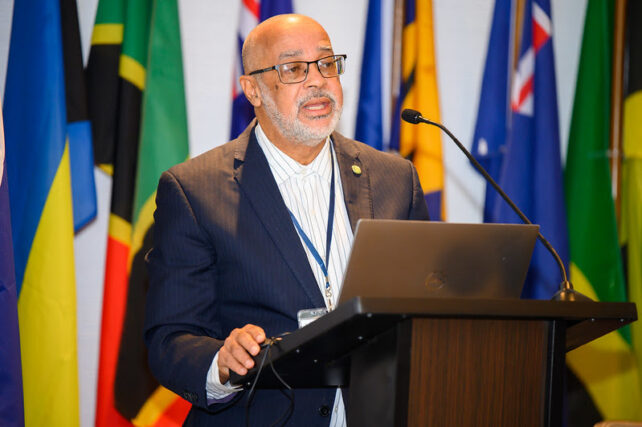
During his keynote address titled “Reimagining the Future (Again): Radical Shifts Needed for Caribbean Education Transformation,” delivered on the final day of the recent Regional Symposium and Policy Dialogue on Transforming Education, Dr. Jules, who previously served as the Registrar and Chief Executive Officer of the Caribbean Examinations Council (CXC), emphasized that the lack of substantial educational reform stems from a failure to view these challenges as interconnected and requiring a comprehensive, systemic approach.
With a background in Educational Policy and Curriculum Instruction, along with extensive experience in education reform and social policy, Dr. Jules highlighted that genuine transformation cannot solely depend on technical specialists or limited strategies like prioritizing Technical and Vocational Education and Training.
He referenced philosophical perspectives that define education’s purpose as fostering human virtue, uplifting the human spirit, and cultivating social and individual values. Dr. Jules also cited the Caribbean Community (CARICOM) 1997 Ideal Caribbean Person, which embodies traits such as emotional intelligence, environmental awareness, cultural grounding, and entrepreneurial skills, as essential values that reflect the true aim of education.
“What do we really mean by educational transformation? The problem is not just a skills problem—it’s a mindset problem. What we really mean by educational transformation is not a technical answer, but a political challenge with deep technical implications, requiring the broadest possible social coalition,” he asserted.
This three-day Regional Symposium and Policy Dialogue on Transforming Education, organized by the Caribbean Development Bank in partnership with the CARICOM Secretariat, OECS Commission, The University of the West Indies, and the Ministry of Education in the Cayman Islands, represents the inaugural event in a series of initiatives designed to tackle pressing educational issues in the region, many of which have been intensified by the COVID-19 pandemic. This symposium also marks a significant advancement towards fulfilling Sustainable Development Goal 4, which advocates for inclusive, equitable, and high-quality education for all.
Commenting on the need for a complete shift in the region’s approach to education and connecting factors, Dr Jules stated that “…driving it all must be a compelling vision and purpose… the why of education. Throughout the entire march of human history, a constellation of thinkers has emphasised the ‘why’ of education. It is this definition of purpose that has guided education systems in every civilisation. Yet it is sad that we in the Caribbean have only paid superficial attention to this crucial question.”
Disclaimer: The comments posted do not necessarily reflect the views of
DominicaNewsOnline.com and its parent company or any individual staff member.
All comments are posted subject to approval by DominicaNewsOnline.com. We never
censor based on political or ideological points of view, but we do try to maintain
a sensible balance between free speech and responsible moderating.
We will delete comments that:
contain any material which violates or infringes the rights of any person, are defamatory or harassing or are purely ad hominem attacks
a reasonable person would consider abusive or profane
contain material which violates or encourages others to violate any applicable law
promote prejudice or prejudicial hatred of any kind
refer to people arrested or charged with a crime as though they had been found guilty
contain links to "chain letters", pornographic or obscene movies or graphic images
I am pleased that Dr. Jules defined the fundamental purpose of education: that being, fostering human virtue, uplifting the human spirit, and cultivating social and individual values. The creative activities which could heal our society, make beautiful the environment, and unite us as a nation, we dismiss as idle, irrelevant and inane.
If the Ministry of Education gave all aspects of the Creativity Arts the attention they deserve we would be making a start on achieving that ideal. Dominica desperately needs creative thinkers and doers, yet we neglect what should be our most valuable resource.
At the beginning of this school term, I wrote to the heads of all our secondary schools offering staff and students help and guidance in the creative arts. Out of eighteen schools only one responded!




I am pleased that Dr. Jules defined the fundamental purpose of education: that being, fostering human virtue, uplifting the human spirit, and cultivating social and individual values. The creative activities which could heal our society, make beautiful the environment, and unite us as a nation, we dismiss as idle, irrelevant and inane.
If the Ministry of Education gave all aspects of the Creativity Arts the attention they deserve we would be making a start on achieving that ideal. Dominica desperately needs creative thinkers and doers, yet we neglect what should be our most valuable resource.
At the beginning of this school term, I wrote to the heads of all our secondary schools offering staff and students help and guidance in the creative arts. Out of eighteen schools only one responded!
………………………………………………………