




In the face of growing climate pressures and continued global supply chain uncertainty, regional bodies are looking to beloved culinary staples of root and tuber crops, known colloquially as “ground provisions”, as a key part of food sovereignty.
At the helm of what is being termed a” definitive regional intervention” are the Organisation of Eastern Caribbean States (OECS) Commission, together with the Government of the Commonwealth of Dominica.
The renewed focus would see foods such as dasheen and tania repositioned not only as traditional staples, but as key drivers of climate resilience, economic opportunity, and regional self-reliance.
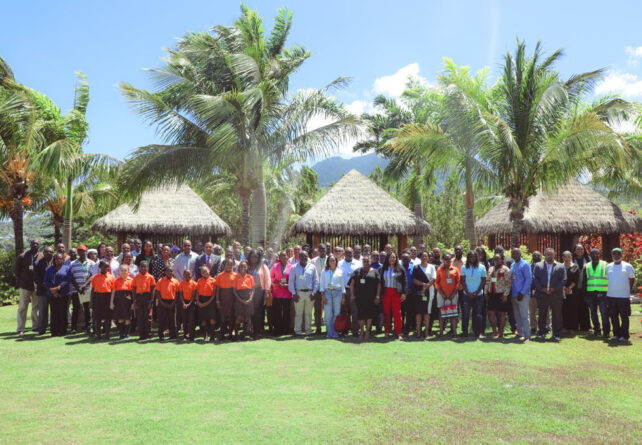
The initiative was formally advanced at the OECS Root and Tuber Crop Symposium, held from May 7–8, 2026, at the InterContinental Dominica Cabrits Resort & Spa.
Bringing together government officials, farmers, and technical experts, the event sought to align agricultural policy with the broader OECS Food and Agriculture Systems Transformation (FAST) Strategy, outline an OECS release.
It also shared that support for the programme is being provided by the European Union under the 11th European Development Fund (EDF), through the Regional Integration Through Growth Harmonisation and Technology (RIGHT) programme.
The discussions took place against the backdrop of high food import dependence across the region, with some Member States reportedly importing up to 90% of their food needs, reinforcing the urgency of shifting toward food sovereignty and the CARICOM “25 by 2025 + 5” target to reduce food imports by 25%.

Representing Prime Minister Hon. Roosevelt Skerrit, Hon. Dr. Irving McIntyre, Minister for Finance, Economic Development, Climate Resilience and Social Security, emphasized that resilience must begin with food systems.
He stressed the direct link between agriculture and national stability.
“The Government of Dominica has consistently emphasized the importance of resilience as a central pillar of national development,” claimed Dr. McIntyre. “That vision of resilience extends directly to agriculture, because no country can truly claim resilience while remaining heavily dependent on imported food and vulnerable supply chains”.
He also acknowledged the ongoing contribution of farmers across the region, highlighting their role in sustaining communities despite increasing environmental and economic pressures.

From a regional integration perspective, OECS Director General Dr. Didacus Jules framed the initiative as a return to foundational principles of sustainability and self-reliance.
He described food sovereignty as a matter of dignity and security, placing particular emphasis on the resilience of traditional crops.
“If we cannot feed ourselves, we are not truly secure,” Dr. Jules cautioned.
He described crops like cassava, dasheen, and sweet potato as poetically resilient, noting they grow quietly, steadily, beneath the surface drawing strength from the soil, holding firm against wind and drought.
He further emphasized that the region’s long-term strength will come from strengthening what is locally produced and deeply rooted, rather than continued dependence on imported food systems.
The urgency of this shift was reinforced by recent climate-related impacts in the region.

Hon. Roland Royer, Dominica’s Minister for Agriculture, Fisheries, Blue and Green Economy, noted that just days before the symposium, flooding and landslides on the island’s east coast had caused significant damage to both crops and infrastructure. He underscored the need to modernize agriculture in response to these realities.
“Agriculture today must be understood as business, innovation, food security and national resilience all working together,” Minister Royer asserted. “If agriculture in the OECS is to survive and grow, then it must become more resilient, more sustainable and more adaptable to the realities of a changing climate”.

Adding to this perspective, Parliamentary Secretary in the Ministry of Education, Hon. Fenella Wenham-Sheppard, highlighted both the cultural and economic importance of root and tuber crops across generations. She noted that these crops have historically sustained Caribbean communities through periods of crisis, while also pointing to their future economic potential.
“Root crops must not only feed us fresh from the soil, they must become higher value products that create jobs, expand exports, and empower entrepreneurs,” she noted.
She further highlighted opportunities to transform these staples into value-added products such as flour, purees, and beverages.
The OECS reports that the symposium concluded with several key outcomes aimed at strengthening the sector’s long-term development. These include the operationalisation of an OECS Food Production Technical Working Group and the development of a dedicated OECS Root and Tuber Crop Roadmap.
Member States also agreed to prioritise investment in supporting infrastructure, including solar-powered cold storage facilities and irrigation hubs, with the goal of modernising agriculture and attracting a new generation of farmers across the Eastern Caribbean.











The “New Caribbean” As the geopolitical map shifts, the time is opportune for a “New Caribbean Image” This is the dawn of a new destination; no longer transitory, laissez-faire, and not only for Tourism (Fun,Relaxation and Play); but also a new permanent place for Business, Work, Living and Retiring. As the masters at Hospitality, we can innovate our hospitality and excel at it in every walk of life; just as we excel at it in Tourism. After all, we possess best hospitality practitioners and experiences anywhere. We can blend our unique brand of hospitality into everything.Let’s package it as also a place to run a business and make money. Let’s reverse the brain drain by showcasing this New Image to our own Diaspora and attract them back home.
Let’s capitalize on our new Geothermal energy.
The opportunities are limitless.
Your actions are so loud I cam hear you when you speak. What happen to the 25 by 25? Just too much talk and too little action. Well done is always better than well said.
One of the key pillars to our survival and economic growth is agriculture. Yet, we just give lip service to this significant sector. Tired of the bogus promises and tomfoolery.