




The bioeconomy functions as a catalyst for sustainable progress, integrating innovation, scientific expertise, and the responsible management of biological resources. The Inter-American Institute for Cooperation on Agriculture (IICA), reports that for Costa Rica, along with the broader Latin American and Caribbean (LAC) region, this sector is viewed as a strategic avenue for generating employment, revitalizing rural economies, and promoting social inclusion. The Agency also said that the bioeconomy positions these nations as emerging leaders in sustainability and transformative production methods.
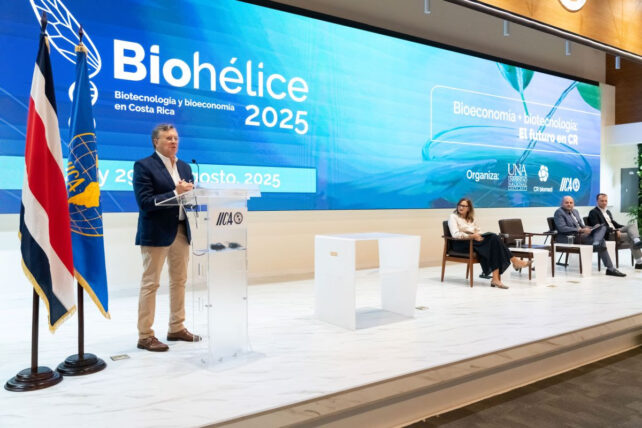
In its press release, IICA shared that this consensus was echoed by experts attending “Biohélice 2025: Biotecnología y Bioeconomía en Costa Rica,” an event organized by the National University of Costa Rica (UNA), the Costa Rican Cluster for Biotechnology, Life Sciences and Medical Devices (CRBiomed), and the Inter-American Institute for Cooperation on Agriculture (IICA).
The two-day gathering, held at IICA’s headquarters in San Jose, convened over 130 participants representing government agencies, academic institutions, scientists, bioentrepreneurs, and investors dedicated to advancing Costa Rica’s sustainable development. The goal was to enhance collaborations between scientific research, technological innovation, and sustainable growth strategies.
The opening ceremony was led by notable figures including UNA President Jorge Herrera, IICA Director General Manuel Otero, CRBiomed President Álvaro Peralta, and Marianela Urgellés, Director General of the Costa Rican Investment Promotion Agency (CINDE).
Herrera highlighted that “Today, innovation and the bioeconomy are pointing the way to the sustainable development of countries. For Costa Rica, the bioeconomy offers a historic opportunity for socioeconomic development”.

He also emphasized that Costa Rica’s reputation for natural beauty and environmental respect positions it well to emerge as a global leader in this sector.
Otero reaffirmed IICA’s dedication to advancing the bioeconomy as a means to transform agriculture and invigorate rural areas. He stressed that this approach fosters job creation, environmental benefits, and new value chains, transforming rural zones into hubs of innovation and opportunity.
“The bioeconomy provides a bridge between production and the environment. We must no longer view it as a threat but rather as a source of enormous opportunities. We support it and hope that IICA will become the leading expert on the bioeconomy in Latin America, promoting public-private partnerships and technical capacity development throughout the entire region” Otero stated.
Peralta underscored the importance of linking scientific research with practical market applications through stronger ties among academia, industry, and public policymakers. He expressed confidence that Costa Rica has the potential to become a leader in bioeconomy innovation, leveraging its skilled talent and distinctive advantages.
CRBiomed’s president remarked that “The country has the opportunity to become a heavyweight in bioeconomy research, development and innovation. This is not a dream but is completely realistic. Laboratory science can be taken to the market, becoming intellectual property for businesses and creating a powerful innovation ecosystem”.

Urgellés from CINDE highlighted the critical role of cross-sector collaboration in advancing bio-innovation as a driver of sustainable and competitive growth. She praised events like Biohélice for serving as platforms that unite key stakeholders and facilitate ecosystem development.
“Biohélice and its synergies are driving the ecosystem forward with dynamism and based on a shared vision. Costa Rica has the capacity, talent and vision to lead the way towards a sustainable and inclusive bioeconomy”, she asserted.
The event’s agenda was structured into two main sessions: Symbiosis and Bioleaders.
The first day emphasized the integration of bioeconomy principles with scientific leadership. Its focus was on fostering the synergy between science, technology, and societal needs, encouraging academia to scale up innovative solutions. Strengthening partnerships among universities, research centers, and strategic players was also a priority to position knowledge as a key driver of the national bioeconomy.
The second day concentrated on multisectoral coordination and fostering public-private partnerships to advance high-impact biotechnologies. Its aim was to facilitate dialogue among scientists, industry leaders, and investors to identify actionable pathways for translating innovation into sustainable economic growth.
Throughout the event, participants engaged in conferences, panels, workshops, and discussions on a range of topics, including international innovation ecosystems, advances in biocatalysis and bioplastics, and successful global examples in sectors such as biofuels for aviation and cosmetics.

Presentations also covered commercialization strategies for startups and intellectual property management. Expert panels analyzed public policies, investment prospects, and pathways for sustainable production transformation in Costa Rica.
During the conference, UNA and IICA formalized a five-year technical cooperation agreement aimed at fostering regional development in the bioeconomy through academic collaboration, scientific research, educational initiatives, extension services, and regional mobility of people and ideas.
Disclaimer: The comments posted do not necessarily reflect the views of DominicaNewsOnline.com and its parent company or any individual staff member. All comments are posted subject to approval by DominicaNewsOnline.com. We never censor based on political or ideological points of view, but we do try to maintain a sensible balance between free speech and responsible moderating.
We will delete comments that:
See our full comment/user policy/agreement.