



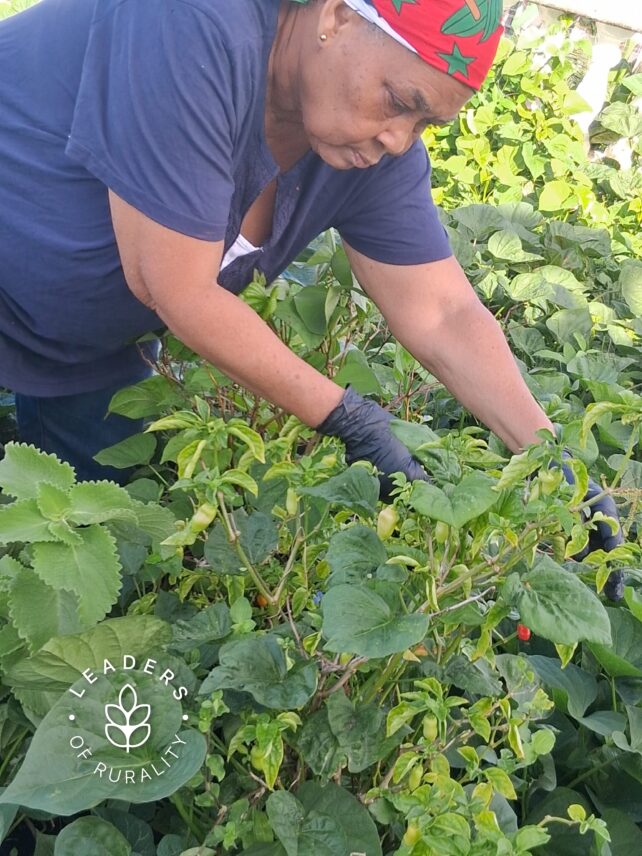
Roseau, Dominica, 23 January 2026 (IICA). Vanya David was born and raised on the west coast of Dominica, in a community where fishing and agriculture continue to shape daily life. Her father was a fisherman, her mother worked the land, and that family environment shaped her early views on food, rural work and self-sufficiency. Today, she sums this up in an idea she repeats with conviction: “What you need to eat is what you grow”.
In addition to having a small-scale farm for her family—where she grows dasheen, a tuber widely consumed on the island and also known as taro or malanga; cush cush, a local dry-textured yam variety; carrots and cabbage—Vanya plays a central role in community organization. She is President of the Dominica National Council of Women, an entity that has, for decades, promoted gender equality, human rights and sustainable development across the island.
Trained as a social worker, she leads crisis prevention and response programs, community strengthening initiatives and joint projects with institutions such as Dominica’s Ministry of Agriculture and the Inter-American Institute for Cooperation on Agriculture (IICA), particularly in technical training for rural women.
For her work as a social leader promoting the self-sufficiency of rural women in her country, and for her consistent message highlighting the value of healthy food that comes from nature, Vanya was recognized by IICA as one of the Leaders of Rurality of the Americas. The Dominican social leader will receive the Soul of Rurality award, created by the hemispheric agency to honor individuals who make a difference in advancing food and nutrition security and sustainability in the region and around the world.
Facing the climate with greenhouses and international assistance
Her perspective on agriculture comes directly from lived experience. She knows the concrete challenges many farmers in Dominica face, particularly older persons. Access to rural roads is, she says, one of the main obstacles: “You do your production, you gather it on the farm, but getting it out of there is the challenge”. The lack of accessible transportation raises costs and limits sales in markets in other parts of the island. This situation affects women in particular, as they seek economic independence but often depend on others to reach their farms or move their harvest. In some communities, they must walk long distances or request transport by motorcycle or pickup truck—something that directly affects safety, time availability and the continuity of their production. For Vanya, strengthening this access is essential to sustaining women’s autonomy.
Climate is another decisive factor. Dominica is a country where sun, rain, drought or strong winds can change rapidly, and each variation affects production. For this reason, she explains, farmers must carefully plan what to plant, in which area and at what time.
With support from the Ministry of Agriculture and IICA, greenhouses have been introduced in recent years to improve the resilience of certain crops. However, not all areas are suitable for installation, which is why projects are implemented in phases—first in accessible zones and later, if results permit, in other communities. This process also includes evaluating which varieties respond best to evolving climatic conditions. Vanya insists that farming is not just about planting: it is about understanding weather patterns and anticipating change.
The work of the organization she leads also extends to the fisheries sector. In collaboration with multilateral institutions, they aim to train women in safer and more efficient techniques for boarding boats, handling necessary equipment and ensuring proper fish conservation practices. Transportation again becomes central: many coastal fishers must travel to mountainous areas to meet their buyers, requiring careful planning of costs and prices. For David, finding this balance is vital to ensuring sustainable incomes and encouraging young people to see rural work as a real opportunity.
Choosing products from the garden
Vanya speaks about young people with a mix of concern and opportunity. Many want to engage in agriculture, she says, “but they need their own land, start-up financing and appropriate tools”. Technology availability also matters: managing irrigation systems, using greenhouses or accessing training requires resources and support. In her own family, some of her children continued working in agriculture, while others opted for education or accounting. Yet all grew up with the “agricultural background” that she considers essential for understanding the value of local production.
Her view on food is direct. Vanya compares the fresh products from local farms with the processed options that dominate cities. To make her point clear, she describes a common scene that could take place in any large supermarket in the world: families who “fill the cart with mac and cheese, quick-cook pasta and cheap low-nutrient foods”, she laments.
This behavior, she explains, reflects a growing trend: busy people choosing what is fastest, even if not the healthiest. “People are always in a rush and buy what is easy. But easy is not always good”, David says. She summarizes this idea with one of her core messages: “More local food production means better nutrition”.
She also knows that agriculture combines moments of satisfaction with others of great difficulty. “Farming can be rewarding, but it can also be a challenge”, she explains. Pleasure appears when producers have access to their land, receive training, have basic tools and can manage their time. The challenge arises when infrastructure fails, when rains or drought lead to replanting, or when transportation makes sales unviable.
Even so, she does not hesitate to recommend this way of life. For her, working the land—even on a small scale—provides healthier food and a more balanced relationship with the environment. She summarizes it with a clarity that runs through her entire rural experience: “It is better to grow what you eat, and eat what you grow”.
I am more than proud that Vanya David is being honored here for her work. Watching her working towards the improvement of women in society. Bless Up daughtet of the soil!!
I salute the patience and hard work of Vanya David. My prayer is that she continues to shine in that area. I grew up in that world where my grandparents worked the land in Fond Cole. It is not easy work, but it is rewarding. In the soil, you see how things live and also how they die. It is a way to foster self employment for both the old, but more importantly the young.
I usually laugh when people talk about organic. I would tell them that I am organic. Vanya David is truly organic. Transportation was a problem for us and is still a problem for her today. I am very proud of the life and work of this woman.
Congratulations to you Vanya, resilient in the circumstances
An example for our young Dominican women
Congratulation to Vania from the fishing village of Layou.
Vanya David is a legendary name in women’s empowerment in Dominica. she has stayed thw course of communitybqork and advocacy from youth and is still a leader in the field. She is known in thw NGO sector throughout the region. Great to see your ecognized Vanya. Keep on keeping on! Hopefully many will be inspired by you, as I am.
Congratulation to Vanya David President of thr Dominica National of Women for receiving this special award. Definitely she continues to work tirelessly most times with little or no financial reward but her belief in advancing women in agriculture, gender equality and women empowerment is well known.
We of the Dominica Council of Women are indeed elated and congratulates her on receiving this award as leader of rurality of the Americas from IICA. Take a bow, my sister well deserved.
Wow! This is great for her and her family and very signifcant for Dominica. Congrats!