




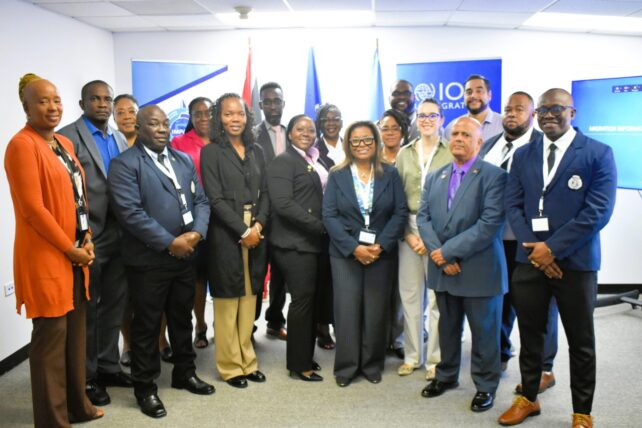
Fourteen government officials from various Caribbean nations successfully completed a Regional Training of Trainers (ToT) program focused on Data Collection, Protection, and Security. The training took place from July 21 to 25, 2025, in Port of Spain, Trinidad and Tobago.
The training was a collaborative effort between the Caribbean Community (CARICOM) Implementing Agency for Crime and Security (IMPACS) and the International Organization for Migration (IOM).
An IOM release shared that the achievement has resulted in the formation of a regional pool of trainers capable of delivering high-quality national sessions on data protection and ethical data usage. Such efforts, says the organization, are instrumental in developing resilient border governance systems and fostering greater cooperation among Caribbean countries to tackle migration challenges and transnational crime.
It forms part of wider initiatives aimed at strengthening border and migration data governance across the region. Conducted at CARICOM IMPACS’ headquarters, the sessions emphasized regional cooperation and capacity-building.
Lt. Col. Michael Jones, the Executive Director of CARICOM IMPACS, highlighted the significance of this training.
He stated, “This cadre of experts was now positioned to deliver enhanced, standardized training across CARICOM Member States to ensure uniform application of data protection and ethical use principles.”
He further emphasized the importance of the training in the context of upcoming operationalization of Passenger Name Record (PNR) systems across the Caribbean by 2026. “As we embrace the complete operationalization of Passenger Name Record (PNR) systems across the Caribbean by 2026, this training was critical to building the human infrastructure needed for intelligence-led border security, enhanced inter-agency co-operation and the protection of personal data in keeping with international standards,” he explained.
Participants included representatives from immigration departments, law enforcement agencies, and ministries of national security and Information, Communication, and Technology (ICT). IOM lists the countries represented as Antigua and Barbuda, The Bahamas, Barbados, Guyana, Saint Kitts and Nevis, St Lucia, and Trinidad and Tobago. These nations were selected based on their strategic geographic locations, their recognition of the need for specialized training in data governance, and their willingness to serve as regional hubs for future training sessions.
There are reported plans to involve additional Member States in subsequent sessions.
Dr. Mashma Sealy, Assistant Commissioner of Police in St Lucia, shared her insights on the training, describing it as enlightening. “During this course, I learned how effective data collection methods ensure accuracy, relevance, and ethical compliance to make evidence-based policy decisions,” she remarked.
She also underscored the importance of data security and data sharing in fostering interagency cooperation while safeguarding privacy.
Ganyell Lewis-Francis, an Immigration Officer from the Bahamas, expressed appreciation for the training’s quality. “The IOM/IMPACS training was exceptionally informative and well-structured, providing both theoretical insights and practical tools,” she said. “The facilitators demonstrated deep expertise and created an engaging learning environment that encouraged meaningful discussion. I now feel well-equipped not only to apply best practices in data protection and security but also to confidently share this knowledge and train others in my organization.”
According to the release, the ToT program integrated technical sessions on data literacy, analysis, personal data protection, information-sharing protocols, and intelligence-led border management. It also included practical exercises and facilitation techniques aimed at preparing participants to cascade the training within their national institutions. Activities such as micro-teaching, role-playing, evaluation design, and the development of national training action plans were key components of the agenda.
Isadora Steffens, IOM’s Programme Support Officer for the Caribbean, emphasized the timeliness of the initiative. “This training comes at a critical time, as Caribbean countries continue to build more integrated and secure systems to manage migration,” she stated. “Ensuring the protection and responsible use of data is essential to safeguarding the rights of migrants and local communities and enhancing policy responses.”
This capacity-building effort is part of the Tripartite Collaborative Action Plan to Combat Migrant Smuggling in the Caribbean, which was developed in October 2024 by CARICOM IMPACS, IOM, and the United Nations Office on Drugs and Crime (UNODC).
Disclaimer: The comments posted do not necessarily reflect the views of DominicaNewsOnline.com and its parent company or any individual staff member. All comments are posted subject to approval by DominicaNewsOnline.com. We never censor based on political or ideological points of view, but we do try to maintain a sensible balance between free speech and responsible moderating.
We will delete comments that:
See our full comment/user policy/agreement.