




Daren Pinard, Dominica’s Minister of State in the Ministry of Labour, was one of several speakers at the recent Caribbean Labour Ministers Meeting, held in Georgetown, Guyana. A report from the International Labour Organization (ILO) stated that the gathering, which took place on April 6 and 7, 2025, aimed to foster decent working conditions, tackle common obstacles, and prepare a strong future for the labour sector in the Caribbean amid global and digital transitions.
This meeting brought together Labour Ministers and their senior aides, as well as key representatives from the Caribbean Employers’ Confederation (CEC) and the Caribbean Congress of Labour (CCL). The theme for the 13th Caribbean Labour Ministers Meeting was “Decent work for resilience: Securing the future of Caribbean labour,” and it prioritized enhancing regional collaboration, advancing decent work principles, and refining labour governance, especially in the face of both global and regional challenges.
On the first day, senior officials responsible for Labour in various Caribbean nations convened to identify key topics for ministerial discussions. Among the issues addressed were the upcoming 113th International Labour Conference, biological hazards, labour standards, social protection, skill enhancement, and the shift toward more sustainable economies. The agenda also encompassed significant matters such as informal employment, migration within the workforce, and the growth of the platform economy.
In addition to Pinard, the formal opening on April 7 featured statements from distinguished guests, including Guyana’s Labour Minister, Joseph Hamilton; Gilbert F. Houngbo, the Director-General of the International Labour Organization (ILO); and Guyana’s Prime Minister, Brigadier (Ret’d) Mark Anthony Phillips. Each speaker underscored the need for collective action to tackle the pressing labour issues facing the region.
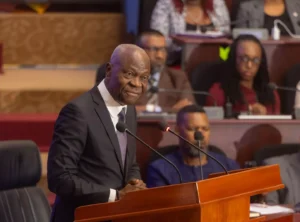
In his speech, the ILO Director-General remarked, “This is a critical moment that calls for a renewed commitment to the core values that inspired the creation of the ILO. Justice, humanity, and peace should guide us as we work towards a new social contract – one based on social justice, equitable economic growth, solidarity, and environmental protection.”
Notably, the ceremony included the signing of Guyana’s third Decent Work Country Programme, reiterating the government’s expressed dedication to fostering decent work and inclusive economic growth while establishing a robust groundwork for quality employment across the country.
Following the signing event, a strategic dialogue took place between the Ministers and the ILO Director-General, focusing on how to align regional goals with the ILO’s Programme and Budget for 2026-2027. Discussions also addressed how Caribbean nations could actively participate in the forthcoming Second World Summit on Social Development and contribute to broader United Nations development objectives.
The region’s shift towards digitalization was highlighted as a significant concern, especially in light of the ILC’s forthcoming agenda regarding standards for the platform economy, which emphasizes the protection of workers’ rights within rapidly changing digital labour markets. Presentations from the ILO Caribbean Office pointed to persistent data deficiencies that may hinder effective policymaking in this domain.
Additionally, stated the ILO, ministers expressed concerns over financial sustainability, particularly regarding the implications of decreased U.S. funding to the ILO and the conclusion of various development initiatives. There was a collective call for improved regional cooperation and greater global representation for Small Island Developing States (SIDS).
Active participation from both the CEC and CCL played an important role in the meeting, reinforcing the ILO’s tripartite structure and ensuring that the perspectives of both workers and employers were included in the discussions.
As the session concluded, the statement said that attendees reaffirmed their collective dedication to advocating for decent work, inclusive labour policies, and enhanced collaboration with the ILO, a move the organization asserts will place the needs of the Caribbean populace at the forefront of efforts toward a resilient and sustainable future.
Every week we hear about the attendance of ministers and government official attending regional and international meetings, symposiums and conferences at the expense of overburdened tax payers. They return empty-handed 99.9% of the time. These meetings are nothing more than mere excursions to these public officials topped off with a decent per diem (cherry on the ice-cream).
The thing that is most hurtful is that nothing changes positively for the mass of the working poor and the unemployed. The vast majority of the citizenry remains dispossessed, malnourished and hopelessly dirt-poor.
One other thing, every one of these rental and international organization we s rested are now practically deceased – UN, IMF, UNESCO, UNICEF, ICC, OAS, CARICOM, WHO, OECS, AU, Commonwealth, etc. The whole world has become a cold, dark and unfeeling place.