




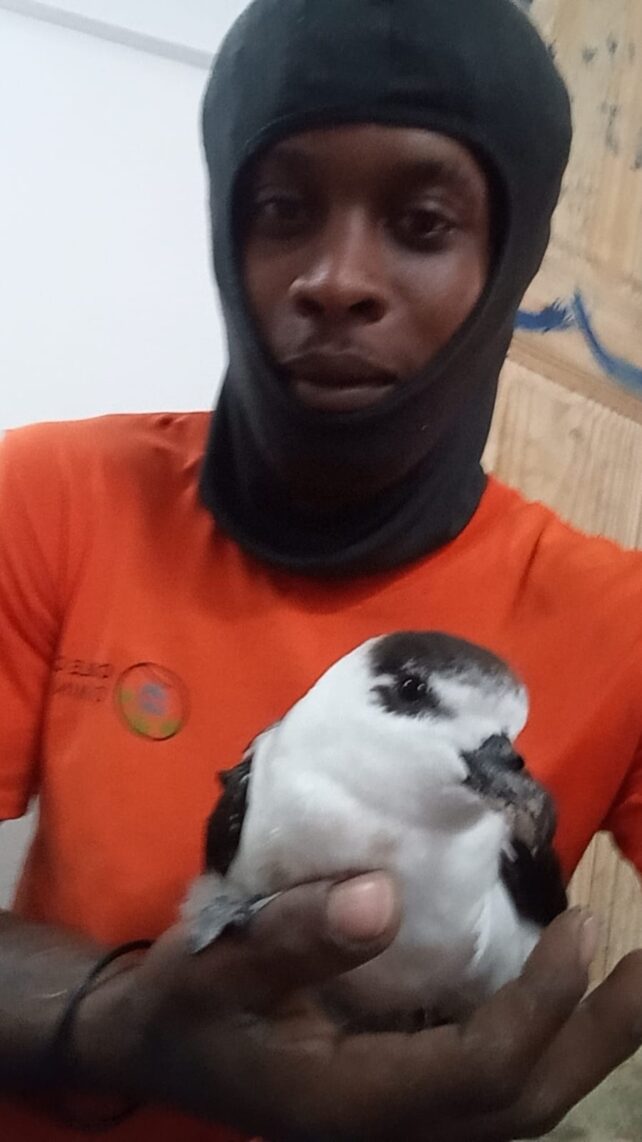
the national park, May 2025. Photo by D. Carbon
There is a very popular expression, ‘A bird in the hand is worth two in the bush’ and some of us may be tempted to turn this to, ‘A bird in the hand means that there are others out there.’
Many years ago, Dominica supported a very healthy population of the seabird known among ornithologists (persons who study birds) as the Black-capped Petrel (Pterodroma hasitata). Locally, this bird is called the Diablotin (written dyabloten in our Kwéyòl language) – a word that means ‘little devil’ on account of the haunting vocalization (call) of the bird. Back then, our population was very significant to the point where two of our mountains were named after those birds: Morne Aux Diables in the extreme north of the island, and Morne Diablotin – the island’s tallest peak – in the
heights of Dublanc and Syndicate.
Over the years, particularly towards the end of the 19th Century, the Dyabloten was thought to have gone extinct (extirpated) from Dominica as no one had seen one of those birds since 1871. However, over the past 93 years three (3) birds of that species have been discovered and collected alive on the island, although two died shortly after being found. It is said that prior to that, the birds used to be hunted for their meat on some parts of the island.

The first such ‘Dyabloten find’ was made by Ms. Mary-Rose Rock on the morning of Monday, May 2, 1932, some 61 years after the previous sighting of a bird of that species in 1871. The bird was found in downtown Roseau, on the step of Miss Rock’s house near Peebles Park, Fort Young Hotel, and the current DOMLEC office.
The discovery of that bird drew a considerable amount of attention back then, both locally and overseas, and even the island’s Governor of the day got involved in the post-capture activities (photographing, confirmation of the species, feeding, caring, publicity, etc). The discovery was first reported in the local press in an article titled, ‘Reappearance of the Diablotin’ which was published in The Dominica Chronicle on May 7, 1932.
That bird was a ‘hen’, i.e. an adult female, it was hand-fed with fish and appeared quite tame, but unfortunately, it survived in captivity for only three and a half weeks (24 days) and died on Thursday 26th May 1932.
The second ‘find’ was made approximately 75 years after the previous discovery, on the morning of Monday, May 14, 2007. That find was made at Padu, at the entrance to the village of Trafalgar, by Vincent Theophile of DOMLEC. Unfortunately, that bird died that night, possibly as a result of heat stress suffered after it was kept in a cardboard box at the back of a vehicle that morning.

The carcass of that bird was kept frozen for almost three years, until a group of petrel experts visiting Dominica in 2010 preserved the carcass on behalf of the Forestry, Wildlife & Parks Division where it was subsequently put on display.
Two very important ‘discoveries’ / observations were made by the petrel team pertaining to that bird while the carcass was being examined and worked upon. Firstly, that the bird had been an adult female, and secondly, and importantly, it had been sitting on eggs at the time it found itself grounded and collected on the roadside at Padu.
Although the discovery of the bird at Padu was first reported in the Division’s 2007 Caribbean Endemic Birds Festival Report, news of the find was shared with the general public only some eight years after the discovery, in an article entitled ‘The Story of a Diablotin Found at Padu, 2007’ which was published in The Sun newspaper in August 2015. That article was subsequently posted on the newspaper’s website on August 19, 2015, where it received 73 likes.
Currently, we are hot on the heels of the most recent find which was made on the morning of Monday, May 19, 2025, this one in the Morne Trois Pitons National Park World Heritage Site. This third bird was collected on the ground by Darnell Carbon of Morne Prosper in the general vicinity of the Top Station of the Cable Car Dominica Project currently under construction; Darnell is an employee of the company.
This third ‘Dyabloten find’ turned out to be a juvenile/fledgling, meaning that it was a young bird that had recently left its nest cavity for the first time. Darnell, who has a keen interest in wildlife, confessed that he had never seen such a bird before. He kept the latter safe in a room at the workers’ quarters where he photographed it, and even tried
feeding it with sardines but it did not accept his offer. He later brought the bird out that night, but it did not fly away. Instead, it merely flapped its wings.

chair. Photo by D. Carbon
The next morning, i.e. Tuesday, May 20, while Darnell was standing outside of his quarters with his new-found feathered friend, which appeared to be quite tame, the latter flew away into the distance.
Questions are being asked about the circumstances that led to this May 2025 Dyabloten find ending up on the ground. But there are many more questions than answers.
News of this most recent discovery was first shared with the general public on May 30, 2025, in an announcement posted on the Forestry, Wildlife & Parks Division’s Facebook Page. A few days later, on June 6, an article on the find was published in The Chronicle newspaper.
Readers may note two sets of coincidences regarding those three Dyabloten ‘finds’: (a) all three birds were collected during the month of May, and (b) also, they were all collected on a Monday!

I wish to thank naturalist/tour guide Elvis Stedman of Laudat, and Darnell Carbon of Cable Car Dominica for the information and sharing photos.
This is more than welcome news; coming particularly after a previously bleak report on the staus of the bird. Haiti is the only other country besides DA where this bird was known to be a resident. May by God’s intervention, there be a resurgence of the Diablotin bird. Thanks again Arlington for your steadfast and sterling service of information to the people of Dominica as per its fascinating flora and fauna.
A well written, comprehensive and informative article…hats off Mr Arlington james for your years if service ,dedication..commitment and sacrifice in the preservation, education and awareness of our natural heritage.
Ive noticed a few things: 1. this bird is very fragile. 2. it has a very strict/peculiar diet. 3. it doesn’t seem to do well in the heat of Roseau, that’s why it prefers the cool regions of laudat, or morne diablotin.
N.B.: we should be very cautious when dealing with this very special and fragile bird in order to preserve its species for future expansion.
Quite an interesting read AJ. The time span between finds(sightings) is really mind boggling.
Now readers know why we have the diablotin mountains.
In the end, cool observation with May Mondays.
Leave the birds alone. ‘Collecting’ them or attempting to care for them does more harm than good. Any bird expert will tell you this.